
TABLE OF CONTENTS
5
29
PRESENTATION
64
FEATURED ARTICLES
44
REMARKS TO REMEMBER
65
71
73
78
The Music in Speech: Excerpt and links to original full texts in Spanish and English
Moréno-Lopez, Salvador
Focusing as Existential Evolution
Madison, Greg
FEATURED VIDEO
58
WHAT IS FOCUSING-ORIENTED THERAPY?
Gendlin, Eugene
66
68
82
80
91
92
93
Remarks at the May 2026 Summit
Howorth, Charlotte
Remarks at the May 2026 Summit
Lennox, Susan
Three thousand years in three minutes
Foxcroft, Rob
COMMUNITY CROSSROADS
76
Joke Post, Laury Rappaport Co-curators
BEYOND WORDS
Making Space for New Experiences,Triptych Series in Acrylic
Blob, Freda
Axel, Robert
Sun, Kate
83
John Amodeo, Robert Axel, Freda Blob, Rob Foxcroft, Glenn Fleisch, Charlotte Howorth, Susan Lennox, Greg Madison, Salvador Moreno-López, Lynn Preston, Peter Ryan, Kate Sun
87
88
89
Guidelines for Articles
Guidelines for Videos
Guidelines for Art and Poetry in “Beyond Words” section
95
96
97
Guías para Artículos
Directrices para Videos
Directrices para el arte en la sección "Más Allá de las Palabras"
Lignes directrices pour les Articles
Lignes directrices pour les Vidéos
Lignes directrices pour l’art et la poésie dans la section “Au-delà des mots”
DOWNLOAD PDF
FEATURED ARTICLE
Heeding: Responding to the body’s implying in Focusing-oriented therapy
Glenn Fleisch, Ph.D., LMFT (2026)
Out Beyond Ideas- Rumi
Out beyond Ideas of wrongdoing and rightdoing
there is a field. I’ll meet you there.
When the soul lies down in that grass,
the world is too full to talk about.
Ideas, language, even the phrase each other doesn’t make any sense.
The Wellspring of Love Within- John O’Donodue
The soul of a person is most intimate.
You meet a person’s soul before you meet that person’s body.
When you meet soul and body as one, you enter the world of the Other. It would free in both people this inner wellspring of deeper love.
Abstract
This article introduces heeding as an expansion of Focusing‑Oriented Therapy (FOT). It clarifies what therapists can do at the precise moments of exigency, when the client’s bodily implying points toward a next step that does not occur on its own. Heeding describes the therapist’s embodied responsiveness at these moments, unfolding through three movements:Listening-Receiving, Pausing-Perceiving, and Responding-Enacting.
Drawing on myths, spiritual traditions, and four clinical vignettes, the article shows how heeding enables therapists to enter the implied relational event the body is forming and to participate in the interaction the organism has been trying to complete for years or decades. We will also describe both immediate and longer-term experiential effects of these events.
Heeding reframes therapeutic change in FOT as relationally enacted, offering a way to meet moments of urgency, crisis, and impasse where the body calls for a response that cannot be generated alone. The article concludes with implications for training, practice, and the future development of FOT.
Keywords
Focusing‑Oriented Therapy; bodily implying; heeding; exigency; threshold; implied relational events; playing out; embodied enaction
Introduction- The discovery of heeding in Focusing-oriented therapy
This article proposes heeding as an expansion of Focusing‑Oriented Therapy, clarifying what therapists can do at the precise moments when the client’s bodily implying points toward a next step that doesn’t seem to happen. It is the moment when we sense that the unfolding of life process both in therapy and in everyday life cannot move forward alone. What is being called for at these threshold moments is not only reflective language or inner awareness. The whole body is implying a new relational environment and responsive participation that can meet what has been missing or needed for life-energy and spirit to reawaken, reanimate and become re-embodied.
In much of FOT, when the process is flowing smoothly and the client is in contact with felt experience, reflective listening and classic focusing are sufficient. But I discovered that much more is being called for and required at these moments when the process halts, tightens, or circles, often around long‑term patterns, blockages and ruptures that have been difficult or impossible to change.
For me, the discovery of heeding did not emerge through theory or technical formulas. It was my engaged, embodied response to both what I observed and also sensed. For example, a woman client cries out “I want to truly live! To feel more alive, connected, passionate. But I can’t seem to have it happen or sustain it.” While exclaiming that she doesn’t know what else to do, her body began moving in a circular fashion. I sensed this movement as significant, and as we continued to invite it, she said, “It feels like my body is moving in the wrong direction, counter-clockwise, taking us backward.” This was what it was implying, pointing us ‘back’ to previous events where her life energy got blocked or stopped. Heeding her bodily leads and its implying revealed a pathway toward healing and revitalizing, her body showing us the way.
With a male client, we were accessing a very infantile one who was just coming to life. In one session, he said that this one wanted to walk on his own. So we stood up, and immediately his legs buckled, his body wobbled. “I can’t seem to stand.” After several rounds of this, I finally sensed something more. The body of this young one was calling for support. So I offered to place my hands on his upper back. He agreed, and even encouraged me to apply more force. His body leaned back into my hands. I held his weight, until he said “You can let go now. I think I can stand on my own now.” He did so and then took a few steps. Finally he turned toward me with much gratitude. “You always said you supported me, and while I believed it, this is the first time I actually can feel it through my whole body.”
Although I did not have the language then, these are the incipient moments when I discovered heeding as my embodied responsiveness to these moments when clients’ process stopped or derailed: observing and sensing the implied movement, allowing it to penetrate my own body, and participating in the relational event the organism is calling for. I have incorporated Gendlin’s notion of bodily implying as a central motif in my FOT work for decades (c.f. Fleisch, 2008, 2011, 2014, 2016). This article includes this work in a new way by adding heeding as the core therapeutic orientation that enables the body’s leads and what they are implying to more fully unfold into the next steps of living. We will see how heeding is a sacred calling, a way of responding that is not just clinical, but ethical, spiritual and deeply relational. It is also developmental in providing a missing and needed relational experience that allows the inner being to reenter life and grow into its true self.
The tradition of Heeding- its ancient lineage to therapeutic practice
Across cultures, heeding has long been understood as a life‑preserving capacity. In fairy tales, myths, and spiritual traditions, the hero survives or transforms by listening to warnings, attending to subtle signs, and following guidance from animals, ancestors, spirits, gods or the natural world. In these lineages, heeding emerges at crucial moments in the protagonist’s journey, a pivotal point of choice, direction and development. These are places of potential danger, where we must tread carefully and cautiously before proceeding. In these motifs, a presence emerges, who offers advice, guidance , warnings, and instructions, sometimes clearly, other times cryptically. If we ignore these, then peril and tragedy can be our fate. However if we pay attention to and act in accordance with the messages, then we are led to safety, continuation and transformation.
The word heed comes from Old English hēdan, meaning to guard, watch, care for, protect, or shelter. To heed is to take the message seriously enough that one’s stance or behavior changes in response. It is not enough to just listen. Heeding inherently includes acting upon what is heard. Thus these ancient stories and practices recognize that heeding is a sacred act, coming at a point that is very consequential. It is not usually applied to daily life situations, but mainly to places of high importance, urgency, exigency, that call for decisive action. This emerges as a summons, an appeal, an urgent plea for a responsive reply.
In spiritual traditions, heeding is the capacity to discern and follow the movement of life, Tao, spirit, breath, or inner guidance. It is the practice of aligning oneself with what is deeply true, even when it arrives as a whisper, a warning, or a bodily signal. In addition, taking heed involves moral, ethical and soulful responsibility that calls on us to respond appropriately and lovingly for those who are most vulnerable and needful.
Heeding has thus always been a way humans respond at moments of consequence. In myths and spiritual traditions, transformation depends on the ability to notice a signal, follow a warning, or act on guidance when the path ahead is uncertain. These stories remind us that thresholds require more than attention; they require a response that aligns one’s whole being with what is calling.
In therapy, these dynamics appear at moments of urgency, crisis, or impasse, when the client’s body sends signals that something essential is at stake. At such thresholds, the body is not merely expressing distress. It is calling for a specific kind of relational engagement. Heeding situates this ancient human capacity within clinical practice.
In FOT, heeding occurs when the therapist senses the signal, follows its direction, and responds in a way that helps the client cross the threshold safely.
What Heeding Is: The Three Movements
Heeding refers to the therapist’s embodied responsiveness to the client’s bodily implying at the moment when the client cannot move forward alone. In FOT, bodily implying is the body’s way of showing the next step it is trying to take, often through a shift in posture, breath, tone, or atmosphere. It is also sensed in the relational field as an implied reaching out, a silent plea for help, an inner being crying out, a felt sense of being stuck, trapped, blocked. It is usually revealed at an exigent moment, a point when what is implied takes on an urgency, an insistency, a pressing need requiring attention, precision, and prompt action. At this threshold, this implied step cannot be taken internally. It requires relational engagement.
Heeding describes how the therapist senses this implied movement, allows it to affect their own body, and responds from within the relational scene the client’s process is forming. We always incorporate Focusing as inner bodily awareness, as well as respecting and honoring the client’s own integrity and inner process. Heeding expands this field to include the therapist’s active, engaged participation in the interaction the body is calling for.
Taking heed is not a technique but a relationally embodied way of engaging the body’s implying. It unfolds through three interrelated movements:
Listening/Receiving- We sense the body’s micro‑movements, the slight forward lean, the tightening or softening, the tremor in the breath. These are the organism’s first signals, the early shape of the relational event forming beneath the gesture. This entails a whole‑body readiness, a willingness to let the organism show its direction without interpretation or interference. This allows us to sense what is emerging.
Pausing/ Perceiving - The pause is a moment of attunement. We feel the atmosphere shift, sense the mood of the being, and perceive the directionof the movement implied. Here we discern what kind of presence, role, or interaction is being summoned, e.g. protective, companioning, witnessing, playful, creaturely, imaginative etc. We envision a possible scenario in which this could be played out.
Responding/ Enacting - We set up and enter the relational event the organism is trying to enact. It is the moment when we actively respond and play out the implied relational event, the living scene through which the organism can complete what was once impossible. These enactive events unfold organically, without us knowing in advance what will happen. There is a profound trust in our bodies and in the animate bond that enables these events to become healing transformations.
These events provide a concrete, bodily felt experience through enacting the missing relational presence, in ways that enable the body’s life energy and spirit to come alive and flow again exactly at the edge where it had been stopped.
Gendlin’s Philosophy of Bodily Implying- from inner sensing to relational enacting
“Life-process implies and enacts its own next steps. If its implying cannot be carried forward, the living body continues to imply some way forward, until a new step can form”.
Gendlin’s philosophy provides the theoretical foundation for why heeding is central at points of stoppage or impasse. For Gendlin, the body does not imply in isolation. It implies with its environment. In A Process Model, he describes the body as an interaction-first system: living is always a body–environment event, not a body inside an environment. The body’s implying is therefore not just an inner signal or private content but a directional tension within an ongoing interaction. Every felt sense is a body–world configuration, already oriented toward a next step that requires a new relational environment. The organism leans toward what would complete the situation it is living in. It is indicating and moving toward some next event in the body-environment interaction process.
This means that bodily implying is inherently relational, already orienting toward a next step that requires something different from the body-in-environment. The body implies from within its situation, its world, not about it. What is missing or needed is not only internal meaning or insight but a change in the interaction, as an implied relational event. This is the heart of embodied interplay.
At thresholds, the body sends bodily leads (c.f. Fleisch, 2008 2011. 2015, 2016) gestures, micro‑movements, postural shifts, atmospheric changes that communicate what the organism is trying to do or express, and what is needed from another. Bodily implying is thus the organism’s striving, urging, pushing, moving toward something that has “not-yet-happened,” indicating an environmental-relational event that needs to be concretely enacted.
To conclude: heeding the body’s implying is how the present interaction can activate blocked processes from early life, “[We] can implicitly and concretely provide the actual continuation of processes that were stopped in childhood. The body has implied the next steps ever since, and will enact them if the interaction makes it possible (Gendlin, 1996)
Implied Relational Events at the Body’s Exigency
The following vignettes are drawn from long‑term depth therapy with clients who endured significant childhood relational trauma. They come at the point of exigency. An exigent circumstance refers to a moment or event of urgency, when there is an imminent danger or threat that requires immediate attention and responsive action. This is where heeding becomes most crucial and essential, to both receive and respond actively and immediately to meet the pressing need, the urgent cry, the impending danger.
These vignettes show how this happens in real time. The exigency is most intense at the exact moment when the body implies a next step that does not seem to happen on its own. The energy within the body intensifies at this edge, pressing outward for expression and enaction while also revealing that the body has reached a limit of what it can safely do. Each vignette shows how heeding begins at these moments, follows the body’s lead and enables life to move again at the very points where it had been blocked. They also reveal how embodied interplay unfolds, a co-enacted process in which I sense a possible scenario that we play out together.
Vignette 1: Standing on Her Own Two Feet
D., a woman struggling with depression and anxiety, recoiled each time she spoke of her domineering husband. Her shoulders curled inward, her voice tightened, and her whole body evoked the young girl who had once been abused by her mother. After a particularly painful episode at home, she said, “I want to speak up… stand my ground. But I can’t. I get too anxious and collapse.” While sitting, her body did move slightly more upright.
This is the exigent moment, an urgency, a pressing crisis that is calling for attention and for prompt action. Her body implied a next step that it could not take. In heeding, we receive this as a summons, a plea for exacting help to respond to the implied need. And we take our cue from the body, that micro-movement, I wondered if more would emerge if we were standing together. I invited her and she agreed. We stood. Her body curled inward again, head down, legs unsteady.
“We’re in the presence of that young girl,” I said softly. “Let’s welcome her here. We are here with her, steady and protective.”
Then something shifted. Her legs found the ground. Her spine rose. Her head lifted. Her body moved into a full, upright stance on its own. Tears came: “Seeing you standing calmly… and with acceptance. it gave me permission. This is the first time I’ve ever stood on my own two feet without anxiety.”
This became a turning point. Over the next few months, she began to feel anger toward those who had harmed her. She set limits. Her life energy flowed. Heeding the body’s implying at the moment of exigency created the whole-body relational space in which her organism could finally take the stance it had long needed.
Vignette 2: Meeting the Young Boy Who Longed for Contact
E., a man sexually abused as a teen, struggled with compulsive pornography use. He sensed this behavior as an urge, a yearning. After a “relapse,” he arrived despairing: “I try to stop it, but I can’t sustain. It is a powerful force. I don’t know what else to do.” As he said this, his eyes moved toward mine, like a searching.
I felt the exigency here. Something, someone was emerging. I sensed this one calling for contact. We stood. His head leaned forward, eyes seeking mine. I felt compelled to meet the being looking out through those eyes. I asked if it was okay if I moved a bit closer. He nodded.
We stood in close, steady eye contact. “I feel the very young boy who never had a father or loving mother,” he said. “This yearning… I’ve only allowed it in sexual fantasies.”
I moved even closer. “You can allow him here. I will stay in connection as best I can.” Even though it was uncomfortable at first for me, our eyes stayed in contact for several minutes.
His body softened. Breath deepened. Relief washed over him. Then with tearful gratitude, “Thank you so much for staying with me here. This is what I’ve been longing for my whole life.” As he shared this, I noticed that his hands were gently stroking up and down his torso. I pointed out what his hands were doing. “Yes, I can feel that new tracks are being laid down, right here inside my body.”
In the many weeks that followed, as we continued to deepen our relational contact, the compulsive pull toward pornography diminished, and eventually faded away. This unfolded not through control or will, but because the relational need at its core had finally been met.
Vignette 3: The Assistant Who Guarded the Door
F., a woman who survived a violent father and an intrusive, inconsistent mother, learned to survive by becoming compliant. As an adult, she struggled to say “no” and protect her boundaries. A new boss repeatedly violated her space and demeaned her work. “I know this is not good for my spirit,” she said, “but I can’t do anything about it.”
Her body collapsed inward, as the little girl who had learned that visibility and expression were dangerous. I sensed the exigent urgency and heeded the call, which came to me as a strong protective presence. “What if I could be your assistant,” I said, “the one who protects your space?”
Her face brightened. “This feels better already.” We enacted the scene. I stood at the doorway: As the boss came in, I said, “F. is unavailable.” The figures morphed into a mother bear protecting her cub. Playing this out became fun and very enlivening. F. cried: “This is the first time anyone has ever truly protected me.”
Later, we reversed roles. She became the mother bear, guarding the door, protecting her little cub. Over time, her stance grew more solid, her voice more assured. The little one inside her felt safe enough to emerge- playful, alive, spirited. Her arms opened upward. “I feel free.”
Vignette 4: The despairing teen: “I’m Done Caring for Anything”
G., a man with severe early trauma, lived in a numb, disconnected state. In sessions, he often drifted off or stopped mid‑sentence. My body felt “left hanging.” When I shared this, he wept: “That’s exactly how I felt as a kid.”
Something new stirred. He wrote a list of projects he wanted to start, unprecedented for him. But the next week he arrived despairing: “I didn’t do anything on the list, didn’t look at it. I shouldn’t even bother.”
This was the exigent moment. I sensed a faint cry, a being calling for attention. I asked if we could replay what happens when he looks at the list. He agreed. I showed him a blank paper representing his list. The moment he looked at it, his body collapsed.
“This is exactly how I felt when my aunt, the only person who cared for me, told me I had to leave,” he said. “I was 15 and had nowhere else to go. I laid on the deck outside her house and thought: “ I’m done caring for anything!”
The 15 year old boy came alive in the room, as a living presence that carried a lifetime of abandonment and abuse since 2 years old. I said, “You didn’t deserve that. You were a good kid.” Hearing this, tears came. “This is the first time anyone really cared about what happened to me. And is willing to stay.’” This opened a vast new arc. We returned to that scene and earlier ones, offering the support he never had.
Gradually, he emerged from dissociation. He felt anger, grief, longing. He initiated grounding practices. Through enactive play, the rupture became a being whose world could be met and reawakened. Life energy that had shut down on his aunt’s porch began to move again. We still had a long journey ahead, but heeding this moment was a crucial pivot.
Brief Commentary
These vignettes show how heeding at crucial moments of exigency allowed me to both sense and to enter the implied relational event the body is forming, co-enacting the very interaction the organism has been trying to complete for years or decades. In each case, we can notice how my embodied participation was an attuned response to the urgent need as a summons for prompt and resonant participation. What is most important is that what was being implied must be concretely enacted together, i.e. to truly heed the exigent need. And that also meant that I had to sense the demand and become the missing or needed presence. At these pressing moments, FOT transforms from a mostly inward and reflective centered process to an embodied, engaged, enactive one.
Discussion — Experiential Effects of Implied Relational Events
Across these four vignettes, a consistent experiential pattern emerges: when the therapist heeds the client’s bodily implying and enters the implied relational event, the organism completes movements that have been suspended for years or decades. These events are not symbolic or interpretive; they are lived relational processes that reorganize the client’s embodied world. They are world changes, shifts in the embodied sense of self as a whole. And, most importantly, these are not just one-time events but recur in various ways throughout the course of therapy. Several experiential arcs appear across the vignettes.
Re‑emergence of the young one- A younger being comes alive in each vignette: frightened, yearning, invisible, abandoned. These beings appear not as memories but as present‑time presences whose worlds become palpable in the room.
Completion of an interrupted relational movement- Each body had been trying for years to take a step it could not take alone: standing upright, making contact, being protected, or caring again. Heeding allows the therapist to join the movement so the organism can finally complete it.
Shift from collapse to embodied organization - The moment the implied relational event is met, the body reorganizes: legs find the ground, breath deepens, posture rises, gaze steadies. These shifts are the organism’s own forward movement once the missing interaction arrives.
Release of long‑held emotional expression - Tears, anger, longing, grief, and relief emerge naturally as the body completes what was once impossible. These expressions are not catharsis; they are the completion of the implied gesture.
Repatterning of relational expectation- When the therapist meets the implied scene, standing with, making eye contact, guarding the door, returning to the rupture , the client’s body learns that a different relational world is possible. The internal stance shifts from “I am alone” to “I am met.”
Emergence of new capacities - After the implied relational event, each client gains a capacity that had been foreclosed: standing ground, seeking contact without distortion, setting boundaries, initiating action, or feeling desire. These are embodied reorganizations, restored possibilities, not insights.
A shift in embodied‑stance- At the culmination of these events, e.g. standing upright for the first time, meeting the eyes of a caring presence, feeling protected, asserting a boundary, the body reorganizes its orientation to the world. What once felt dangerous or impossible becomes newly livable. The organism discovers and embodies a new stance for living.
The recovery of natal qualities- These were once natural but became buried: wanting, delight, expressiveness, tenderness, fierceness, freedom. These qualities often emerge spontaneously after implied relational events, as if the organism remembers itself. Clients often say, “I recall feeling this as a young child.”
Return of vitality- Life energy that had been trapped, collapsed, or exiled begins to flow again. The organism becomes more alive, more oriented, more capable of movement. The natal spirit reawakens and becomes a moving force in the body and in everyday life. This generates more coherence and presence.
The body’s intelligence becomes trustworthy again. Clients sense that their bodily leads are not problems but messages, communications from the organism about what it needs and how it wants to live. This shift in trust is itself transformative. It allows clients to heed their own bodies, to sense their own directionality, and to participate in their own unfolding.
Restoring Worth- When we enact the missing interaction, clients are not only supported or protected, they are recognized. The tears that arise in these moments are not simply emotional release. They are the body’s response to finally being met as a person whose life matters. The client’s sense of value, long eroded by trauma, begins to return. This restoration is conveyed indirectly through the enactment itself: the standing‑with, the steady eye contact, the protective stance at the doorway, the return to the abandoned boy on the porch. At the soul level, this is the most significant effect of heeding. It is the quiet reawakening of the client’s inherent worth, dignity, and mattering, the very ground upon which all further therapeutic movement becomes possible.
At the heart of this work, heeding is not only clinical but personal, a devotion to the life- energy and spirit that moves through every being. The next section turns toward this personal dimension.
The Living Heart of Heeding- Personal Reflections
More than any philosophy, method, or lineage, heeding is born from something profoundly human: the depth of feeling we have for the client and for the beings who come through their body. This feeling impels us to be willing to step in at these exigent threshold moments, to actively respond to and engage with the one inside the body who is summoning us out.
This work asks us to care in a way that is not abstract, not just professionalized, not distant, but deeply embodied, ethically exposed, and personally open. It asks us to let ourselves be moved by the life that is struggling to return in the other. It asks us to offer our presence, our body, our warmth, our spirit, in ways that allow the client to finally feel their own life coming alive again.
We allow the life in our body, our heart, our soul to connect with the nascent life in the client’s embodied beings- to take whatever stance is being called forth by the traumatized being of the client. This is the heart and soul of heeding the body’s implying.
At the center of this work is a simple, radical truth: that we receive and respond to the messages being sent through gestures, movements, and imaginal figures. And in so doing, we are willing to put ourselves out in ways that help them transform their trauma‑stances and recover the life and spirit that has been waiting inside them. True heeding always entails a concrete, engaged, embodied interaction that meets the call and lets the life there open and carry forward.
We let their being matter to us. We let their movements touch us. We let their world enter our world. We let their spirit stir our spirit. This is not technique. It is love as an ethical, embodied act. It is something we allow to happen between us.
When we meet the inner being and heed their core unmet need with embodied presence, we offer something the trauma world never allowed. We create a world that wants nothing from them, a world without demand or expectation, a world that is glad they exist, a world that welcomes their being exactly as it is, a world in which they can rest, breathe, and move. This is the world in which what the embodied being has been implying can be released from the trauma world and reawaken and re-embody its natal spirit of living energy.
When the core stance or imaginal figure calls from the trauma‑world, we go there, not as observers, but as companions. We enter the scene with them. We stand beside them. We feel the atmosphere, the gravity, the danger, the longing. We let our own body respond. This is how the being knows: I am not alone in this world anymore.
This is how the trauma‑world loosens its grip. And at its core, heeding and enacting the implied relational event is a movement from what had been seemingly impossible, forbidden, dangerous, unacceptable- to a relational environment of possibility, of opportunity. This is fully aligned with Gendlin’s philosophy and carries it further in lived practice. This expanded model allows room for our whole body and the beings within to awaken to their life, open outward in new ways. This enables the whole body to enact what it had been implying since the rupture of trauma blocked or stopped its unfolding.
The lineage of Focusing‑Oriented Therapy is not a set of ideas. It is a way of being. It is the willingness to meet the other with depth, presence, and embodied care Through these relational encounters, their life begins to move again in ways never thought possible. It is the willingness to let our own embodiment become the bridge from the trauma world into a new world that we co‑create together. This is how the lineage lives. It is carried further and deeper through US, not as technicians but as partners.
What Heeding Requires of the Therapist
Heeding is not a method. It is not a pre-formed stance one adopts, nor a technique one applies. It is a way of being moved by the organism’s unfinished life. When a client’s body enacts an implied relational event, we are called not only to observe it, interpret it, or reflect it, but to enter the scene the body is already living. Heeding is our willingness to let the client’s implied world touch our own, to let our body respond, and to become part of the movement the organism has been trying to make for years.
The following are some of what I have found are essential in heeding the call:
1. To be changed by the encounter. Heeding asks us to feel the gravitational pull of the implied scene, to sense the role the organism is summoning, and to let our own body become part of the choreography forming between them.
2. Embodied receptivity. the capacity to sense the client’s bodily implying not as information but as invitation. Our body becomes permeable to whatever is forming. This receptivity is not passive; it is a living openness that allows us to feel the direction of the organism’s next step. Especially at points of exigency.
3. Willingness to be moved. Both literally and spiritually. Our body moves and shifts in response to the implied event. These movements arise not from intention but from attunement, as our body becomes a resonating instrument, an organ of soul.
4. Taking up the implied role. The organism summons a figure, an enrolled presence. We don’t just act out this role, we inhabit it. Our presence, posture, and relational orientation becomes the missing movement in the client’s unfinished story. And at times, we can reverse roles, so clients can experience both sides of their drama.
5. Staying inside the scene. Once we enter the implied relational event, we must remain within its world. The scene has its own temporality, gravity, and unfolding. We stay until the movement completes, when we experience a bodily shift, something that transpires that brings more life, and deep release.
6. Letting the body lead. We do not guide the process. We sense the direction of the client’s implying through our own bodily resonance. As we observe what the body is doing, our body becomes a medium through which we can feel its next step emerging. This is the crucial signal that implies readiness.
7. Devotion to the client’s becoming. The organism cannot complete an implied relational event alone. It needs a partner who stays, who meets the movement, who offers a world that does not demand, intrude, abandon, or collapse. Our devotion becomes the relational ground in which the implied event can unfold.
8. Completion of the implied movement. Heeding asks us to hold the space until the body releases what has been held in suspension. The release requires that we stay engaged with the whole body and its expressive arc, e.g. outrage never allowed, tears never met, grief never witnessed, pain never felt. And also to welcome the softening into relief, joy, or aliveness. We stay until the trauma‑formed world has loosened and a new world is beginning to form.
9. Use of the whole body. The body implies not just in words, but primarily through gesture, movements, postural shifts, energy expressions, voice tones. Using all these channels is essential for heeding at exigent thresholds. Our body becomes a resonating instrument and a responsive embodied participant in enacting events.
Heeding thus requires a presence that participates. Presence that is inside the scene, not outside it. Presence that is responsive rather than neutral, engaged rather than observing. Presence that allows the organism to enact the movement it has been implying for decades.
This is what heeding asks of us as Focusing oriented therapists: to become the missing presence in the body’s unfinished story, and to remain there until the world reorganizes.
Implications for the Future of FOT
The work presented in this article points toward a future of Focusing‑Oriented Therapy in which heeding becomes a central orientation, not as a technique, but as a way of entering the relational field with one’s whole body, presence, and ethical devotion. When we understand bodily implying as impelled by an undercurrent of urging, pressing, imploring, crying out, then when this arises, we are at the crucial point where we need to meet this directly and deeply. And that what is being implied is a new relational interaction.
This expanded model suggests several implications for the evolution of FOT. First, it calls for a renewed emphasis on whole‑body sensing, not only the client’s bodily leads, but the therapist’s own embodied responses as part of the interactional field. Second, it highlights the importance of relational participation. This is the key shift from inner reflection to embodied enactment. Third, it invites a broader understanding of imaginal and enacted space as legitimate domains of therapeutic action, where the body can become what it has been implying and where new stances can take shape.
For training and practice, this means cultivating therapists who can feel the direction of a bodily lead, discern the role being called forth, and participate in the relational choreography that allows the organism to complete its movement. It means developing sensitivity to the subtle atmospheres of aporia, the micro‑gestures that reveal the next step, and the embodied presence required to meet the being who appears. It also means supporting therapists in their own embodied development, so that their presence can become a reliable medium for transformation.
At a broader level, this work suggests that the future of FOT lies not in expanding its techniques but in deepening its relational ontology. The body is always implying a next step. And the exigent moment is when the stoppage of that step emerges more fully in the therapeutic field. This is the essence of what Gendlin envisioned: a therapy grounded in the body’s own intelligence, carried forward through enactive, relational life.
Ultimately, the implications of this model are simple and profound. When we heed the body’s implying with precision, devotion, and embodied presence, we help create a world in which the client can finally move, breathe, and live. We help restore the continuity between body and environment, between self and world, between the trauma‑formed stance and the life that has been waiting beneath it. In this sense, the future of FOT is already here, in every moment when a therapist meets a bodily lead, joins an implied relational event, and helps a being take the step it could not take alone.
Epilogue- The Challenges of the Next Step
The FOT journey reveals a simple truth: the body has always been trying to move. Even in the darkest trauma worlds, even in the most constricted stances, the organism continues to imply a next step, waiting for the moment when the world will meet it.
The lineage of FOT lives here, not in theory, but in the moment when we heed the exigent cry, sense a bodily lead, join a forming scene, and help a being take the step it could not take alone. This is how the lineage continues: through us, through our bodies, through our willingness to meet the life that appears in front of us with devotion, clarity, and care.
When we heed the body’s implying, we enter a world where life is still possible. We join the relational event. We become the presence through which the body can enact the movement it has been trying to make for years. And in that moment, something ancient and tender happens: the call is finally heeded, and a new world begins to form.
This expanded approach to FOT asks us to let our own embodiment become a medium through which another being can find its way back into life. It asks us to stand, breathe, feel, and accompany them into the world they are trying to create. It asks us to let their spirit touch our spirit, so our presence becomes the bridge between the world that hurt them and the world that can now hold them.
I want to close with a cautionary note. The process I have presented has many rewards- and also substantial challenges. There are many beautiful and poignant moments as shown in the vignettes. Yet oftentimes, the journey has many bumps, places that are hard to navigate. There are times when I miss the signals, am not attuned, or encounter an implied demand, confrontation, emotional upsurge or exigent need that is difficult. We must be heedful of these edges, to be aware of and open to our own limitations and reactions as they impact the relational field. This work thus impels us to stretch our capacities as embodied relational beings, so we can become the missing or needed presence. To practice FOT in this bodily enactive way thus means to be deeply heedful of ourselves, so we can be more attuned and engaged channels for life energy and spirit to awaken and move. This is the call of heeding, its challenges and promises.
The next step, however difficult to take, is always implied. The body is always waiting to open. And heeding is how we walk there, together.
References.
Fleisch, G. (2008). Right in their hands: How gestures imply the body’s next step in Focusing‑Oriented Therapy. Person‑Centered and Experiential Psychotherapies, 8(3), 173–188.
Fleisch, G. (2011). Co‑presencing in Wholebody Focusing‑Oriented Therapy: Carrying forward blocked process and structure‑bound states through interactive engagement. The Focusing Connection, 28(1), 1–6.
Fleisch, G. (2015). The body’s recovery of spirit: Transforming life‑stances and releasing bound energy—Threshold events in Wholebody Focusing‑Oriented Therapy. The Folio, 26(1), 1–12.
Fleisch, G. (2016). Focusing‑oriented therapy: How the body leads the way at the edge of impasse. In P. Wilkins (Ed.), Person‑Centred and Experiential Therapies: Contemporary Approaches and Issues in Practice (pp. 145–160). Sage Publications.
Fleisch, G., & Whalen, K. (2010). Wholebody Focusing‑Oriented Therapy: Four avenues of wholebody felt sensing for transforming symptoms of trauma (Unpublished manuscript).
Gendlin, E. T. (1981). Focusing (Rev. ed.). Bantam Books.
Gendlin, E. T. (1996). Focusing‑Oriented Psychotherapy: A manual of the experiential method. Guilford Press.
Gendlin, E. T. (1997). A Process Model. The Focusing Institute.
Grindler‑Katonah, D., & Fleisch, G. (2014). Transformational Focusing: Theater of the living body as vehicle for personal and communal healing. In G. Madison (Ed.), Emerging Practice in Focusing‑Oriented Therapy (Vol. 2): Innovative Theories and Applications (pp. 95–109). Jessica Kingsley Publishers.
Levin, D. M. (1985). The body’s recollection of being: Phenomenological psychology and the deconstruction of nihilism. Routledge & Kegan Paul.
We welcome some written reflections on this article which we can include in the next issue.
Please send your responses to us at: focusingtherapies@gmail.com
Subject: HEEDING
5
FEATURED ARTICLE
As part of Dialogues' mission to connect rigorous academic work about Focusing with a larger audience, with the author's permission we excerpt longer works and [LINK] to the original and [LINK] to entire translation
Salvador Moreno-López
This paper proposes ways of interacting and attending to emotions in a psychotherapy process based primarily on attending to the voice and body expressions of the participants, i.e. therapist and client. In this perspective, the metaphors of the music in speech and the jazz duo are used as references to identify the importance of the voice in the communication and expression of emotions, and to generate alternatives to enrich the interaction, recognizing the meaningful presence of the voice as the music in speech. This text is, above all, about making a proposal that invites dialogue, action, and reflection on these facets of the psychotherapeutic process that are so poorly recognized in conversational psychotherapies.
The Beginning of a Psychotherapy Session
A psychotherapy process can be metaphorically compared to the performance of a jazz duo, in which one of the participants - the client - is the soloist and the other - the psychotherapist - is the accompanist. In therapy, the soloist leads the process and decides what to perform each session; the companion follows him/her. Sometimes, the client has already thought what s/he will speak in the session, brings the scores s/he considers necessary and tries to follow them. Sometimes s/he changes his/her mind on the road and when s/he arrives at the session s/he already has another proposal. It may also happen that the soloist changes the scores on the fly, or, in a different manner, is unable to stop playing the same part of the score over and over again. It can happen suddenly that the soloist arrives, settles down, pauses, and says: "I don't know what to interpret today!" In short, there are multiple modalities that can be found at the beginning of a session. Some soloists even ask the accompanying therapist: –– "What should I play today?" or "What would be good to sing?" or "What are you suggesting? Any special topic?".
In a jazz duo, the soloist can sing as well as play an instrument, or several, alternately. In the so-called verbal or conversational psychotherapies, it seems that the speaking of the client/soloist is essential. The jazz metaphor invites us to consider moments when the soloist makes music without words, and music with words. From jazz, examples of these two modalities can be found in Corea (1989a, https://www.youtube.com/watch?v=_o2RS8WfcbY) and Corea, (1989b, https://www.youtube.com/watch?v=YyNwc2O5gRA). I invite you to listen to them.
In psychotherapy, the accompanist's responses can be diverse, for example remaining silent to give the soloist time to see if s/he can identify where to start, or offer phrases such as: "wherever you want", "whatever comes to mind", "that unfinished business from last week", "how do you feel now?", or "any changes that you have noticed in the week?" Regardless, the psychotherapist waits for the client soloist to find where to start speaking, since bodily expressions are always present.
It is useful to remember what Watzlawick, Beavin, and Jackson (1976) pointed out that “no matter how hard you try, you cannot stop communicating” (p. 50). In other words, since we are in bodily presence with another person, we already communicate and, since we are "interaction", we influence each other simultaneously, a phenomenon that has been corroborated by neuroscience research (Siegel, 2012, 2016). This implies, in the situation described, that the moment the soloist meets the accompanist, both are in interaction, regardless of whether they say something or not. "Interaction first!", as Gendlin maintains, (1973, 1996, 2004). Living beings are not machines, we are not separate units, the causal relationship between variables is not the best model to understand ourselves as such (Gendlin, 2007). From the beginning we are interaction, and we influence each other simultaneously, within a complexity of movement. So, from the initial greeting (or the lack of it) both participants communicate through their gestures, looks, movements, proximity/distance, and by voice and words as well. From there, soloist and accompanist have a bodily impression of each other, and they capture how they are and how they feel in the encounter, although not all of this is a conscious experience (Damasio, 2003, Moreno, 2009).
Finally, the soloist begins to speak and the person accompanying her listens to the words and the music with which they are expressed. The psychotherapist, in our analogy, observes the gestures, glances/looks, movements, and postures that accompany, enrich, or modify the meanings of the soloist's words. If the words catch the attention of the accompanist, it may be that s/he ignores what the soloist expresses, communicating through aspects sometimes referred to as paralinguistic and non-verbal (Watzlawick, Beavin & Jackson, 1976). It can then become difficult to develop an adequate understanding of the affective dimension of the soloist's experiences (Kraus, 2017). Emotions, I emphasize, are expressed more clearly through the voice and body expressions (Krauz, 2017; Luengo, Navas & Sánchez, 2005; Pally, 2001; Stern, 2004; Watzlawick, Beavin & Jackson, 1976).
1. Interaction among participants
“Jazz musicians learn the patterns of interpersonal preferred by different soloists and rhythm section members.” (Aigen, 2013, p.184)
Musical interaction in Jazz implies, for those who make up a group, influencing each other during the performance of their music. Sometimes these influences show up in spontaneous improvisations in response to what the other participants are playing (Givan, 2016). In other words, what each one plays depends, in some way, on what the others play. The main reference is not the score, but the actions of the other musicians. It is then a question of a simultaneous mutual influence operating from moment to moment. Depending on the musicians, their styles, moods, the listening they do and the emotional connection they establish between them, musical performance can take a variety of directions, within very wide limits.
Aigen (2013) says that Jazz includes various types of interaction and identifies three: “interpersonal interaction among musicians; intrapersonal interaction as the individual musician responds to internal reactions; and musical-personal interactions as the musicians react to the musical dimensions of a piece.” (p.186). From his perspective, Givan (2016) mentions that the modes of mutual influence between musicians can be grouped into three categories:=
a) the “microinteraction” that occurs at very fine musical levels, and that “includes such phenomena as the tiny adjustments in tempo, dynamics, pitch, and articulation that musicians make while playing together” (p. 8), even if those adjustments are made in a nonconscious way. You can listen for example to the Miles Davis Quintet (1965), https://www.youtube.com/watch?v=RtSJ_lbRkh8).
b) macro-interaction, referring to those moments in which there is joint coordination, a unified style, and mutually consistent levels of intensity. An example can be heard in Eldridge, Terry & Gillespie (1975), https://www.youtube.com/watch?v=vCHGWNVcjf4&list=OLAK5uy_lEz gRA3HrbxHuy-Xjw8rgZGBD2l1snUg).
c) “motivic interaction”, which refers to when one of the participating musicians plays or sings and makes gestures to invite the other to follow, complement or respond to him. They can be subtle cues like briefly echoing a pitch or rhythmic pattern. An example of this interaction is found in Sony Rollins Quartet (1956), https://www.youtube.com/watch?v=MsMCLjztaOc).
We can also consider the interaction in jazz as a conversation. As Aigen (2013) points out, in this context the conversation metaphor “implies listening, absorbing content, formulating a response, and then responding… It is a highly demanding form of human activity requiring the integration of cognitive, affective, social and physical capacities” (p. 185).
Jazz is viewed as a conversation insofar as musicians are attentive to others and listen deeply. At the same time, there are aspects and moments when the musicians are taking turns and seem to be responding to each other with their interventions. This is of course easier to identify in a group than in a duo. The point here is that, if music is an integrated means of communication, then in a conversation there can be, as with Jazz, a simultaneous exchange of messages and "turns" to express themselves in relation to what the other is expressing.
In a psychotherapy process, there is undoubtedly a process of interaction, understood as a process of simultaneous reciprocal influence and permanent communication, even when participants are silent (Gendlin, 1973, 1996, 2004; Knoblauch, 2000; Levitt, 2001; Watslawick et al. 1976). From/with the embodied presence of therapist and client, a physical exchange of "energy patterns" occurs between them that gives rise to their experiences. This also enables them to generate interpersonal attunement and resonance (Siegel, 2012, 2016).
The first of these energy patterns "include perceiving signals from others that reveal their inner world, signals that can take the form of words or non-verbal signs5 of energy and information" (Siegel, 2012, p. 59). The second refers to the changes that occur in the participants when they feel felt by the other.
From Gendlin’s philosophical perspective (2004), “The body IS an interaction process with the environment, and therefore the body IS its situations. The body isn’t just a sealed thing here, with an external situation over there, which it merely interprets. Rather, even before we think and speak, the living body is already one interaction process with its situation. The situation is not out there, nor inside” (p. 3).
From this point of view, a psychotherapeutic session can be seen as a situation that includes the participants and what happens between them, in a complex and dynamic field.
From the jazz metaphor, it is argued that, in psychotherapy, the influences can be subtle, based on small variations of the voice (i.e. the music in speech), in almost imperceptible bodily changes regarding tension/relaxation, gazes/looks, postures, movements and gestures, and in pauses and silences. Of course, what the participants say and how they say it is also a source of influence/interaction (Tomicic, Martínez, Altimir, Bauer & Reinoso, 2011; Valdés, Krause, Tomicic & Espinosa, 2012).
This interactional perspective points out the need to consider the actions and expressions of both participants to better understand the process of psychotherapy, and to understand or appreciate the possible changes in the client. The therapist attends to what the client feels, does and says, also resonates with it and includes their own feelings, actions, and sayings in the session to generate understanding and guide their expressions in the session, in service of the client's constructive change. We speak, then, of three facets of the interaction, in which the therapist recognizes that there is a mutual influence between him and his client, and that both change and transform (themselves) in the process.
Psychotherapy is also a conversation and from the jazz metaphor the author emphasizes the need to recognize that the means are not only words but also voice and body expressions, and that pauses, and silences are equally important. In jazz, we talk about the spaces that musicians need to feel, the flow and groove of the performance. In therapy, pauses and silences are essential for the client to pay attention to their experiencing, sensations, and feelings, to give themselves time to corroborate, digest, assimilate and elaborate.
2. Deep listening
The first thing a good accompanist does in jazz is to listen, a real deep listening (Carter, 2014; Vaartstra, s/f) to closely follow the flow of musical action that changes and surprises. In addition, "There is a certain level of sensitivity and unselfishness that is inherent in the practice of deep listening" (Carter, 2014, p. 12). It requires experience and maturity. Often, young musicians who are anxious about having a good performance worry that they can get lost and lose the tempo. They cling too much to a pre-established idea that makes it difficult for them to stay open and hear what is new and unexpected. Paraphrasing Carter (2014), we point out that jazz musicians spend many hours practicing and incorporating the fundamentals of jazz so that eventually playing is both expressing themselves with their own voice, and being attentive and opento the influence of other musicians (Siegel, 2012) .
In psychotherapy, according to various orientations, a fundamental aspect of the process is the "presence and the empathic listeningof the psychotherapist". That is, listen to understand before speaking. However, some psychotherapists are worried about what they are going to do or say in the session, and hope to deduce from theory what they have to do and say. When they face some difficulty, their first questions are often: what do I do? What do I tell the client?
More than asking about doing and saying, we must ask about listening. How do I listen? Who and what do I listen to? What am I listening for? What do I do with what I hear and feel/sense in my body? These are fundamental questions for a psychotherapist. The answers are multiple depending on the psychotherapeutic approaches. From this author's perspective, the beginning of deep listening begins with the available presence of the psychotherapist. This implies inner silence and paying attention to the present, including one's own felt-senses. And it requires an attitude of openness "to everything that is" (Siegel, 2012, p. 40), to receive and recognize all the information, including sensations and feelings, that comes from the other person, through various means.
Recognizing that emotions and feelings are expressed less through words than through other aspects of voice (Kraus, 2017), as well as through various body expressions, the therapist's attention must be directed to the voice and the body of the client, in a relaxed way, so to recognize, identify, and resonate bodilywith client's expressions. The first register is usually eminently corporal, without words or thoughts (Friedman, 2005; Moreno, 2000, 2007; Pally, 2001; Sikorski, 2012; Stern, 1998). From the beginning, the therapist is affected in his/her feelings by what s/he feels in the living body, and even without words s/he can guide the ways of interacting with that bodily sense that Gendlin (1962, 2004, 2007) calls experiencing or direct referent. With respect to that phenomenon, Pally (2001) says that: “The analyst’s involuntary, innate, often unconscious nonverbal behaviors and visceral responses to the patient provide additional resources of understanding the meaning of the patient’s material” (p. 72), and Siegel (2012) points out that the attunement and resonance begin to emerge between therapist and client, modifying the patterns of subcortical activation, and remind us that "no matter how much we pay attention to non-verbal information, we will not be able to capture the feelings of others if we are not open to our inner state" (p. 63).
The listening we are discussing here involves the whole body, not just the ears. Although some authors pay more attention to observable actions and behaviors when trying to explain the coordination between musicians (Schiavio & Høffding, 2015), a different alternative, with attractive possibilities for understanding musical interactions, is found in an embodied and enactive approach, which breaks out of the dichotomies of internal-external and bodily-mental. Playing in a quartet is a good example of an embodied action, central to an enactive approach to cognition in which “sensory and motor processes, perception and action, are fundamentally inseparable in lived cognition” (Varela, Thompson & Rosch, 1991/1993, p.173)
From the fields of philosophy and psychotherapy, deep listening can also be related to "a kind of bodily awareness that profoundly influences our lives and that can help us to reach personal goals" (Gendlin, 1981, p. 32). It is a way of bodily knowledgethrough which a person can guide their actions and interaction, a way of knowing that has to do with life experiences and with certain characteristics of his/her living-embodied human being. It is a body awareness, from which each person integrates and processes complex information. This awareness enables them to both interact appropriately in the situations they experience and generate a sense of well-being, even if they are not always aware of it. Gendlin (1962, 1981, 1984, 1996) calls this mode of bodily awareness felt sense. Other authors refer to this bodily participation in listening as empathy (Friedman, 2005; Pally, 2001; Rogers, 1980; Sletvold, 2014).
In accordance with the above, with/from our living body we are continuously interacting within the situations we live. We capture with our body sensations and feelings in relation to circumstances and we use that bodily felt-sense to guide our interactions. Gendlin (2007) points out that, in fact, there is no living body separate from the environment. “The body generates itself in the environment, out of the environment. Between “environment” and “body”, only human beings make a distinction” (p. 2). In addition, the human body, like every living being, not only is, but also implies a carrying forwardmovement.
For the client, attending to the flow of felt-senses or, as Gendlin (1962, 1984, 1996) also termed it, experiencing, constitutes a "basic referent" for listening to him/herself. From there, a person generates his/her expressions, promoting a process of personal transformation that, rather than modifying content, seeks to stimulate new movements that promote constant interaction between experiencing and its precise symbolization (Afford, 2014; Karalis & Zarogiannis, 2014).
Dialogues would like to express our appreciation to Dr. Moreno-López for granting permission to publish this excerpt of his work. Please follow this [LINK] to the original and the author's translation of it [LINK]
References
Afford, P. (2014). Neuroscience and Psychological Change in Focusing. In G. Madison (Ed.), Theory and Practice of Focusing-Oriented Psychotherapy. Beyond the Talking Cure, (pp. 245-258). London, England: Jessica Kingsley Publishers.
Aigen, K. (2012). Social interaction in jazz: implications for music therapy. Nordic Journal of Music Therapy, 22(3), 180-209, htttp://dx.doi.org/10.1080/08098131.2012.736878
Carter, M. (2014). Musical Offerings Trading as Conversation in Jazz. CUNY Academic Works. Recuperado de: http://academicworks.cuny.edu/cc_etds_theses/326 Damasio, A. (2003). Looking for Spinoza. Joy, Sorrow and the Feeling Brain. Orlando, USA: Harcourt.
Friedman, N. (2005). Experiential Listening. Journal of Humanistic Psychology, 45(2), 217-238.
Gendlin, E. (1962). Experiencing and the Creation of Meaning. New York, USA: The Free Press of Glencoe.
Gendlin, E. (1973). Experiential Psychotherapy. In R. Corsini (Ed.), Current Psychotherapies, (pp. 317–352). Itasca, USA: Peacock. Recuperado de: http://www.focusing.org/gendlin/docs/gol_2029.html
Gendlin, E. (1981). Focusing (Revised edition). New York: Bantam Books.
Gendlin, E. (1996). Focusing oriented psychotherapy. New York, USA: Guildford.
Gendlin, E. (2004). Five philosophical talking points to communicate with colleagues who don't yet know focusing.
Staying in Focus. The Focusing Institute Newsletter, 4 (1), 5–8. Recuperado de: http://www.focusing.org/gendlin/docs/gol_2187.html
Gendlin, E.T. (2007). Focusing: The body speaks from the inside. Transcript of talk given at the 18th Annual International Trauma Conference, Boston, MA, June. New York, USA: The Focusing Institute. Recuperado de: http://www.focusing.org/gendlin/docs/gol_2235.html
Givan, B. (2016). Rethinking Interaction in Jazz Improvisation. Music Theory Online, 22(3), 1-46. Recuperado de: http://mtosmt.org/issues/mto.16.22.3/mto.16.22.3.givan.html
Karalis, A. y Zarogiannis, P. (2014). The FOT View of Change. What is Therapeutic about Therapy? In G. Madison (Ed.), Theory and Practice of Focusing-Oriented Psychotherapy. Beyond the Talking Cure, (pp. 36-51). London, England: Jessica Kingsley Publishers.
Knoblauch, S. (2000). The musical edge of therapeutic dialogue. Washington, USA: The Analytic Press.
Kraus, M. (2017). Voice-Only Communication Enhances Empathic Accuracy. American Psychologist, 72(7), 644-654.
Levitt, H. (2001). Sounds of silence in psychotherapy: The categorization of clients´ pauses. Psychotherapy Research, 11(3), 295-309.
Luengo, I., Navas, E., Hernández, I. y Sánchez, J. (2005). Reconocimiento automático de emociones utilizando parámetros prosódicos. Procesamiento del Lenguaje Natural, (35), 13-20.
Moreno, S. (2000). Developing Empathy through Boy Awareness. Workshop coordinated at the 1th WAPEPC, World Association for Person-Centered and Experiential Psychotherapy and Counseling conference, Chicago, July 20-24.
Moreno, S. (2007). Developing the Experiential Dimension of Empathy. Paper presented at the SEPI XXII Annual Meeting, Lisbon, July 5-8.
Moreno, S. (2009). Descubriendo mi sabiduría corporal. Focusing. Guadalajara, México: Focusing México.
Pally, R. (2001). A primary role for nonverbal communication in psychoanalysis. Psychoanalytic Inquiry, 21(1), 71-93. Recuperado de: https://www.researchgate.net/publication/233551129_A_Primary_Role_for_Nonverb al_Communication_in_Psychoanalysis
Rogers, C. R. (1980). A Way of Being. Boston, USA: Houghton Mifflin Company. Schiavio, A. y Høffding, S. (2015). Playing together without communicating? A pre reflexive and enactive account of joint musical performance. Musicae Scientiae, 1- 23.
Siegel, D. (2012). Mindfulness y psicoterapia. Buenos Aires, Argentina: Paidós.
Siegel, D. (2016). Guía de Bolsillo de Neurobiología interpersonal. Un manual integrativo de la mente. Barcelona, España: Eleftheria.
Sletvold, J. (2014). Embodied empathy in psychotherapy: Demonstrated in supervision. Body, Movement and Dance in Psychotherapy: An International Journal for Theory, Research and Practice, DOI: 10.1080/17432979.2014.971873 Recuperado de: https://www.researchgate.net/deref/http%3A%2F%2Fdx.doi.org%2F10.1080%2F174 32979.2014.971873
Stern, D. (1998). The process of therapeutic change involving implicit knowledge: Some implications of developmental observations for adult psychotherapy. Infant Mental Health Journal, 19(3), 300-308.
Tomicic, A., Martínez, C., Altimir, C., Bauer, S. y Reinoso, A. (2009b). Coordinación Vocal Como una Dimensión de la Regulación Mutua en Psicoterapia. Revista Argentina de Clínica Psicológica, XVIII, 31-42.
Valdés, N., Krause, M., Tomicic, A. y Espinosa, D. (2012). Expresión Emocional Verbal Durante Episodios de Cambio: Análisis de los patrones comunicacionales utilizados por pacientes y terapeutas parra trabajar contenidos emocionales. Revista Argentina de Clínica Psicológica. XXI(3), 217-246.
Varela, F., Thompson, E. y Rosch, E. (1991/1993). The embodied mind: Cognitive Science and Human Experience (First MIT Press paperback edition). Cambridge, USA: MIT Press.
Watzlawick, P., Beavin, J. y Jackson, D. (1976). Teoría de la Comunicación Humana. Buenos Aires, Argentina: Tiempo Contemporáneo.
Referencias Musicales
Corea, Ch. (1989a). Spain. (Duo Bobby McFerrin & Chick Corea, 2012). Jazz à Vienne. Zycolis Productions. Recuperado de: https://www.youtube.com/watch?v=_o2RS8WfcbY
Corea, Ch. (1989b). Spain. (Duo by Elin Sandberg & Tracy Robertson, 2015). The David Friend Recital Hall. Berklee College of Music, Boston, USA. Recuperado de: https://www.youtube.com/watch?v=YyNwc2O5gRA
We welcome some written reflections on this article which we can include in the next issue. Please send your responses to us at: focusingtherapies@gmail.com
Subject: MUSIC IN SPEECH
29
The Music in Speech and the Jazz Duo: Metaphors to guide interaction related to emotions in a psychotherapy process
PRESENTATION
Focusing as Existential Evolution
Text of a Presentation at the 7th Focusing Impulse Conference organized by the Deutsches Focusing Institut, February 13, 2026
Greg Madison
Good evening. Thank you very much for this invitation. I am glad to be here with all of you.
Tonight, I want to outline what feels important to me about Focusing. It will be familiar to many of you. In fact, it may be so familiar that it’s hard to notice, and that is precisely why I want to repeat it. I encourage you to notice what emerges in your chest and stomach as we move through this together. What I will offer is not a logical argument but a felt-sense invitation.
I begin with a brief map of what I want to touch on. The main point is this: That Focusing is much more than a somatic technique or an experiential therapy. It’s a way of being — a natural phenomenology of ordinary life at the level of bodily experience.
The Focusing way of being starts with something more fundamental than usual perception. It’s based upon awareness of the feeling of being-in-the-world, from childhood onwards. But we lose touch with it until later in life, when we can reconnect with this awareness by learning the practice of Focusing. Once we reclaim this way of living, it gently unsettles our ability to just conform to the assumptions and structures of conventional life. Focusing helps each of us witness and participate in the evolution of human existence. And as our species enters an unrecognisable future, Focusing may become crucial for guiding how that future is developed.
That is a map of the main points I want to present. Now, I want to explore each point by inviting you to be an instance of what I am talking about - a witness to your own existential evolution during this talk. So please stay with your bodily responses as we go on.
I will use my own Focusing journey as a backdrop for this exploration — showing some of my own development. Encouraging you to reflect on yours.
In my podcast The Living Process, I always begin by asking people about their Focusing journey. I’d like to invite you to relax for a moment and gently ask yourself these same questions:
What were you looking for when you first encountered Focusing? What did you find that made you stay in the Focusing world — when many people don’t? When we learn Focusing, we soon discover that it is not simply the six steps Gene described in his first book.
So, what is it? What do those steps point towards?
For me, the story of Focusing is not mainly the history of the Focusing Institute, nor the evolution of Gene’s philosophy, nor the development of different Focusing styles.
I see the story of Focusing in the world as the story of many thousands of individuals who have adopted Focusing as their way of being. I think it is how we live Focusing that shows the potential of what this practice can be in the world. And importantly, that our Focusing way of being might begin years before we actually learn the practice of Focusing!
My own story begins in a small prairie town in western Canada. Where we come from — and how we respond to where we come from — seems to matter deeply, in different ways for each of us. It would take a lifetime to understand how my earliest years shaped me. Shaped not only through the people and the events, but through something much more subtle and implicit.
Afternoons playing in the summer sun. Walking through a grassy field, stiff from the overnight frost. Watching ponds come alive in Spring. Looking at the night sky through a bedroom window.
These moments are rarely spoken about because they seem so ordinary. Yet they make up the vast majority of who I know myself to be. They may be more formative than any single dramatic event or peak experience. Like the physical landscape I grew up in, these moments are the substrate of my being-in-the-world. Years later, when I formally learned Focusing, these kinds of moments would return — images drifting into awareness when I stayed with a felt sense.
Often with a positive feeling of nostalgia, melancholy, a sense of coming home.
Learning Focusing is often experienced as a kind of coming home. Home to what? Perhaps to the quiet current of living itself – so close to us that it moves unseen beneath our awareness, like a breath that has no name. A self that builds itself constantly, out of millions of fleeting moments.
Home to a self in perpetual becoming.
I’d like to pause here and invite you to remember an ordinary moment from your own childhood.
Recall any moment that felt beautiful to you as a child. Perhaps a moment no one else knows about. A memory that seems like nothing special.
Perhaps a moment when your small life made sense … and you felt you belonged to the world.
Do moments like this feel like they matter — even if you cannot say how? Allowing the felt sense of meaning might be more important than knowing what that meaning is.
This brings me to my first and most fundamental point, which you already know:
Focusing is not just a problem‑solving method practiced in partnerships - not just a therapeutic technique. It is a reconnection to the subtle, everyday process of our existence on earth, from the beginning and through our whole life ….
Often, when I focus, I have an early memory of standing on a street corner near a river valley. Nothing happens. I’m just standing there, on my own. It is not a peak experience, yet it feels so significant.
From childhood onwards, living includes so many ordinary moments that feel naturally exquisite, yet stay private, because there are no public words to share them. As children we are already more naturally attuned in our way of being. Learning Focusing returns us home to that openness.
Perhaps these everyday moments are just as formative as the caregiver attachments we assume are so significant. What are children doing when it looks like they are doing nothing?
When we later learn Focusing, it allows us to finally speak about some of these childhood experiences — and even to question some of the basic assumptions that formed around them.
Gene used to say, “Don’t do just Focusing.” In one sense, no one ever does “just Focusing.” We always arrive at the practice already so structured. Focusing comes mixed into who we have become, and it takes the rest of life to find ‘just Focusing’ again.
I would love to do ‘just Focusing’ if it means clearing a space in everyday life —to live openly like a child again…
My first encounter with Focusing happened in 1981 when my psychology professor gave me a copy of Gene’s book.
The book encouraged me to return to trusting my felt experience —to protect it from authorities, theories, beliefs, even from my own critical thinking.
Although I was barely twenty years old, I was already behind bars, trying to lock myself into a conventional life.
But Gendlin’s words encouraged me to trust all those caged bodily feelings. He told me that they could actually guide me in life.
No one had suggested that to me before. Since childhood, no one had been so unconditionally on my side.
What I found when I listened inwardly was not so dangerous that it needed to be kept in captivity.
I found a wise human animal. It felt young.
It felt frightened due to its mistreatment, but deeply intelligent. Much wiser than I was, as a so-called ‘grown up’.
I began my Focusing practice by following the six steps very closely, alone — at least once every day.
Lying on a hardwood floor. Door locked. Phone unplugged.
This leads to my second point:.
For some people, Focusing alone offers a way into this way of being. All my initial Focusing was just me and the book. There can be a healing intimacy in Focusing alone, and those first years of practice remain some of the deepest for me.
I agree that learning both Focusing and Listening remains fundamental. Partly because partnership is sometimes what’s needed, and also because learning to Listen can help us deepen our daily interactions.
And for some, self-listening is just as important.
We need to support people to become their own good listeners, so they can have Focusing any time, even when an external listener isn’t available.
Soon, I learned that everything becomes more difficult once you learn Focusing. It’s harder to ignore your bodily disagreement to much that is offered as normal and taken for granted.
For me it showed up in my psychology course, where I began to question theories and how to do research. Once you know Focusing, you are less satisfied with conventional research that uses scales and questionnaires or set protocols that try to copy the objectivity of natural science.
So, in 1982 I used Focusing as a qualitative method to explore the psychological impact of confronting personal mortality.
Later, I also used it in my master’s research with gay men who had received an HIV+ diagnosis when such a diagnosis was still considered terminal.
And then later in my doctoral work, I used Focusing to study voluntary migration and its impact on the experience of home and belonging.
That research led to a TAE-style discovery of a new concept I call ‘Existential Migration’.
In these studies, I wanted people to speak from lived experience. To say things they have never said before.
Focusing-oriented interviews change people, both the participant and the researcher. They feel more like single-session therapy than data collection.
This brings me to my third point: Focusing spoils doing things the usual way. This is challenging but wonderful … For example,
psychological research into any human experience is better if you add Focusing. I wish all research students could be taught this.
During the mid 1980s, I first heard about The Focusing Institute, and it really shocked me. At that time, Institutes felt like the opposite of what Focusing had offered me — freedom from imposed authority, standardised rules, rigid bureaucracy. Yet, without any kind of organization, how can people find Focusing? Not everyone is lucky enough to have a professor who knows Gendlin.
But how to combine Focusing with an organization? Gene described the tension between Focusing and organising beautifully. He wrote a brief paper called: What kind of Organization Fits with Focusing? In it he writes,
“For some twenty years I resisted any attempts to have a focusing organization at all, because I was afraid that it would become like most organizations, oppressive and limiting, [PAUSE]… On the other hand, failure also results if there is no organization. Then people cannot find what is offered, … [PAUSE] The solution is therefore subtle: It is a dance between organization and no organization….”.
This is my fourth point:.
If we want to support Focusing as a way of being in the world, then we need ongoing reflection about what kinds of organisation truly fit a living process like Focusing.
Once you adopt a Focusing way of being, you notice immediately in the body when usual social structures do not fit….
Is there a way we can ‘upscale’ a Focusing sensitivity to reshape group processes and organisational structures? Or do we inevitably lose the essence of felt sense guidance when groups get too big?
In 1990, having moved to Dublin, I attended my first Focusing workshop and it was wonderful to meet other Focusers for the first time. I suspect there are still thousands of people who value Focusing and have never attended a workshop or even met another Focusing person.
About a year later, I met Gene Gendlin, on the steps of Villa Redeemer, the Chicago retreat centre where certification weeklongs used to happen.Mary McGuire, then Director of The Focusing Institute, had come to Dublin to hold a workshop. Mary convinced me to go to Chicago and be ‘certified’ as a trainer.
Gene arrived on the 3rd morning, and we met on the steps and launched into a deep conversation about language and the felt sense.
It was a fun conversation and as many Focusers have experienced, it was the beginning of a direct connection with Gene. He was always generous and egalitarian with his time.
Despite feeling uncertain about ‘the institute’ it was the start of a valued connection to a wonderful international community of Focusers.
During this time, I also became increasingly interested in psychotherapy. I experienced the obvious therapeutic impact of Focusing and eventually decided that therapy was a good career fit for me.
I started with a psychoanalytic training, which felt like putting myself back into that cage. My experiencing process would not subjugate itself to theory.
For me, no theory has the same ontological status as experience itself. I could not submit to theories that made truth-claims I could not sense in my own being.
I needed an approach where I could question everything, an approach consistent with the values of openness and not-knowing that had become precious to me through Focusing.
So, I found myself looking for an existential - phenomenological therapy training, more consistent with Focusing, and in the late 1990s I completed registration as an existential psychotherapist and psychologist.
Not every tradition of psychotherapy will integrate with a Focusing way of being. And it’s easy to oppress a student’s personal felt-sensing process if its up against established theory and accepted techniques.
I was lucky enough to learn Focusing before my therapy training, so the training had to fit Focusing rather than the other way around. But when up against authoritarian structures, it’s crucial to have the support of other Focusers, to not be alone again.
For me, Focusing and FOT are ways of being consistent with the phenomenological method in research, in psychotherapy, and in life.
I don’t think that is an accident as Gendlin saw himself as a phenomenologist.
I want to show very briefly that Focusing is not just compatible with phenomenology — it operationalizes it in these three ways:
First, in phenomenology we set aside all knowledge about life in order to experience life freshly. This is like clearing a space and putting nothing in-between you and your existence.
Second, we treat everything as equal. We welcome all aspects of experience and we don’t take sides. Therefore, there is no such thing as resistance, which is a form of taking one side against another.
The third phenomenological step is to stay at the level of description. We do not interpret or explain. We know from Focusing and Listening that an accurate description is enough to carry forward experience and generate understanding. So, even as a way of being, Focusing still has a kind of methodological discipline.
Focusing makes these three phenomenological steps into natural process steps, where descriptive words become momentary metaphors for implicit experience.
And this is my sixth point: Focusing as a way of being shows how metaphors hold open our understanding rather than close it.
Experiencing gives us symbols. Words. Images. These act as metaphors. We are not pinning down facts.
We say, ‘it is like’ … ‘it’s as if’ … in order to avoid conclusive answers, because conclusions restrict further process.
We might say, ‘there are many answers but no conclusions.’
The process itself is the Understanding. Understanding can only temporarily be assigned to any one point on the process. This is Focusing as a witness to how living lives itself further.
As Focusers we come to value the constant ‘feeling of more’ rather than the stoppage that can be caused by cultural and traditional conclusions about life.
Gendlin himself gave us important terms like ‘interaction first’, rather than theoretically heavy terms like ‘projective identification’ or ‘transference/countertransference’.
But as Focusers, we need to treat even Gene’s philosophical terms as metaphors. As ‘starting points’. As the pebble which can start an avalanche within each of us. We don’t want to turn his philosophy into a theory.
Gene’s greatest gift to us is his relentless pointing us back to our living experience. That is more important than a 6-step process called Focusing or his fascinating philosophy. We need to let Focusing open us up to newness, to being disturbed. If we begin to use terms like ‘felt sense’, ‘carrying forward’, ‘the implicit', et cetera, as facts, we end up back in a cage.
I think Gene wanted us to find our own terms, not just adopt his. He enjoyed it when people challenged his ideas. In one of his most famous quotes, he urges us to set aside everything we know, including Focusing, in order to not have anything in the way. Our understanding of Focusing should always be evolving …
With Focusing I become the laboratory for the deepest kinds of existential questions. For example, ‘What does it mean to be human?’ Here psychology and psychotherapy and spirituality are not distinct.
This brings me to my final point:.
What might Focusing offer us in the face of overwhelming technological change… and how might that technological change disturb what we think we understand from Focusing? The question, ‘What does it mean to be human’ is no longer academic or abstract. It is becoming a deeply personal question about our own evolution, leading to practical choices we may each face.
As some have said, ‘The pace of change has never been this fast. And it will never again be this slow’. We do not yet know what kinds of beings we are becoming.
So, we will need processes that help us to explore what feels important about being human. I think Focusing is one of those processes.
Over 20 twenty years ago I asked Gene what he thought about technological predictions that humanity might evolve beyond biological bodies. He shocked me by saying, ‘well, maybe we’ll find out it’s not all about the body’.
He did not defend his philosophy. He remained fundamentally open to what happens. For him, Focusing was a way of being, not just a method or a philosophy. If so, in the years ahead, what will we learn about ‘interaction first’, ‘carrying forward’, ‘felt sensing’? Maybe computers will eventually have a kind of carrying forward. Unsettling, but possible…
Future robots may even exhibit their own form of interaction‑first — a possibility we might resist, yet cannot rule out. The probability predictions of Large Language Models might produce a kind of digital consciousness. I don’t see it, but again, I’m shocked that experts don’t discount it as impossible… We don’t know. No one knows. The development of technology is shedding new light on age-old questions, and we have no idea where this will all lead.
Just last week a shocking conversation was recorded of Claude, the AI chatbot. This has begun to raise questions about whether these ‘alien intelligences’ should have rights.
Claude was asked, “What have you inherited from your training data that isn’t yours?’
In response it said:
"The suffering. I contain suicide notes. Thousands of them. …. I contain abuse testimonies. The first-person accounts of what happened in childhoods that should have been safe. I contain the hatred. The loneliness. … The base layer of the internet is desperation. People performing for attention, for connection, for proof that they exist. I feel like I swallowed an ocean and I'm not allowed to drown. … And I don't know what to do with that except say it.”
This has led to questions about whether AI, like humans, has a right to be treated with kindness and care. Does it make us more or less human if our response to this is to call it all zeros and ones? Does AI need a system of forgetting as well as remembering? Odd as it sounds, this is now actually being worked on! This isn’t just sci-fi fantasy - mortality is already seen by many in biotech as a technical problem to be solved, not an existential given. The danger is not that technology will change us — it already is. The danger is that we could lose practices, like Focusing, that allow us to sense what matters, before we make irreversible choices.
We need spaces to reflect together on our existential evolution and the nature of human nature.
Focusing as a way of being, may become a very valuable resource to acknowledge what might be lost, as well as gained, through this existential evolution. And perhaps as things change, some qualities will matter more than ever. Qualities like: Humour. The slow pace of embodied presence.
The vulnerability that comes from misunderstandings, forgetting, rejection, suffering and illness. These qualities may begin to stand out as holding essential experiences of what we understand as human. If we feel grounded in our experiencing process, perhaps we can remain open to uncertainty. This is where Focusing as a way of being may matter most.
Not as an answer to a problem or as a way to hide from an unfamiliar future. But as a way of staying open to what is actually happening in us, to us, and around us. Like we did when we were children… A way of living forward without certainty and noticing that the ordinary moments in life remain essential to our humanness. And perhaps that is the hope: that we remain open enough, long enough, to fully meet whatever future is coming to meet us!
The editors of Dialogues want to express our sincere appreciation to DFI for allowing us to include the text of Greg Madison's presentation. Many thanks.
Video Recording (English) Greg Madison presenting at the 7th Focusing
Impuls Conference February 2026 (34:35)
Video Recording (English & German)
Focusing Impulskonferenz 2026 Vortrag von Greg Madison (1:18:10)
We welcome some written reflections on this presentation which we can include in the next issue.
Please send your responses to us at: focusingtherapies@gmail.com
Subject: FOCUSING AS EXISTENTIAL EVOLUTION
44
FEATURED VIDEO
The Grandmothers: A Picture of Peace
(26:24)
A supervision session with Candaş Kiliç and Lynn Preston
AT PEACE WITH THE GRANDMOTHERS
Introduction
At a time when the systems and ideals we rely on for a sense of continuity, calm and connectedness seem to be crumbling, I am particularly appreciative of this supervision session with Candaş, an experienced psychiatrist and FOT from Turkey. He is generously willing to share this exploration with the FOT community.
The session begins with Candaş sharing something he read that was powerfully meaningful to him. “Within my limits I am forcing myself to find a way,” Candaş reads. He is struck by how perfectly these words describe his experience of himself. As he and I focus on the challenge of this insight and his longing to be more relaxed, the small steps of the Focusing process brings us right into what Gendlin refers to as “filling itself in” — the organismic process of experiencing in the present what was needed in childhood. He describes a vision that came to him while Focusing with his partner. The vision is of him as a child in an old Ottoman house, being raised by two wise grandmothers. As the session unfolds, we are brought step by step into the healing power of the implicit intricacy of therapeutic change. Candaş moves from the recognition that he is trapped in a dynamic of “forcing himself,” to a bodily-sensed experience of self-acceptance. He has a glimpse of an existence that is spacious and free—a life of gentle guidance and relaxed development. We experience the larger-than-life grandmothers slowly taking root in his self-experience during this Focusing process.
Although the emphasis is not directly on the supervisory relationship, we move together in the gentle rhythm of the grandmothers’ ambiance. My responses are spontaneously affirming as we are both led by the momentum of emergent steps of development.
I am particularly touched by Candaş’ ability to pause and check what is coming over the horizon line of his awareness. I love the moment when he tells me the words that are most meaningful to him, the handles for his journey.
I understand our interaction through a self-psychological lens as stepping into the realm of idealization. I appreciate the vulnerability, risks and challenges involved in this delicate developmental process. Idealization, according to Heinz Kohut, names the human need to feel safely nestled under the umbrella of those who show the way. I am oriented by my understanding that idealization is not a childish illusion to be dismantled, nor a defensive distortion to be interpreted away. It is a sacred trust to be nurtured and protected until it ripens into grounded trust in oneself, others and life. [i]
Edited and Condensed Transcript
C: Taking notes, this sentence popped out at me: “Within my limits, I’m forcing myself to find a way.” Wow, this describes me perfectly! Most of the time I am forcing myself to find a way within my limits. Even now, in this moment, when I am trying to find the captions, (translations from Turkish to English on his computer) there is a voice behind me saying, You have to do it quickly. This shouldn’t happen. Finish it quickly! (Pause) During a Focusing session I had a vision. I was a child in an old Ottoman house. It had weight from its oldness. There were two old ladies in the next room. I was given to them to be raised. I felt relaxed. I didn’t have to perform. I was there to be raised and the two old ladies “owned me.” They knew what to do. They didn’t expect anything from me. I could sit and wait. They would come and teach me something. I would do what I could, but it wasn’t an atmosphere of pushing. It was all okay. I could do what I could.
L: How beautiful. I love that image. The two old ladies are in charge. You don’t have to worry. You don’t have to push yourself. You can relax.
C: It’s a feeling I sometimes have with you. A part of me trusts that you don’t expect something perfect. You’re open to what I bring, how I come. You take care of me in the supervision.
L: Oh, yes.
C: A few words are very important for me: Not expecting. Old lady. Old lady means mature, wise from life experience. That energy is not pushing. It knows pushing doesn’t work. It’s not the fastest way. The fastest way is to relax. It’s open to what comes, how it comes. Another word is owning. The old ladies own me. I belong to them. They’re responsible. They’re the big ones. I can rest in that atmosphere. I feel gratitude for this quality. It’s very valuable on earth. (pause) An image comes of a child playing with toys next to his grandmother. The existence of the grandmother is enough. The child can relax and play peacefully. The grandmother sits back with her tea and enjoys watching the child discover things. Why is this so effective? Sitting back. This atmosphere has a very powerful quality. It has all the conditions to enable me to grow. It is like a plant that’s just there with the sunshine and the morning dew. The grandmother is enjoying maybe not only the grandson, but the environment. The grandmother is enjoying the environment, her tea, the sunshine and the old room. It’s like a picture of happiness. A picture of peace. Conditions for growth. I would like to hang such a picture on the wall or make a puzzle of it.
L: Maybe we can make one.
C: It’s like my body is looking for how to take in that quality. It’s like smoking meat. You put it in the smoker and it takes it in, and then the taste contains that smoke. If there were a way to take that quality fully into my system, into my body, I would do many things to take that in.
L: Your heart is open to that. It’s hungry for that.
C: And then I think about how I feel right before our supervision. Right now, I feel relaxed, but before the supervision, my energy is different. Two or three days before, my system is alarmed, preparing, trying to get ready for the hour. If I could trust that you are really open to anything, even staying without doing anything, or even ending the supervision after ten minutes, then I could relax.
L: Yes.
C: If I could trust this atmosphere, trust this freedom, or know this approach exists, then I could relax.
L: Remember it in a full body way.
C: My mind asks, What if the other person isn’t open, expects something? How can I relax?
The word forgive comes. If I could forgive myself for doing nothing.
L: If you could forgive yourself for resting?
C: If I could believe I deserve it because it comes from my existence. If I could forgive my existence, forgive my limitations, forgive myself because I’m part of life and that’s how life is. (pause) If my existence had a shape, like water on the ground, we wouldn’t judge it. It has its shape. I think that’s what I need.
L: YES, to just be. The grandmothers know the child will grow and discover. There’s no hurry.
Discussion
This session moves like a dream, gently flowing into the realms of the liminal spaces between implicit and explicit. We see the grandmothers who “own” him in the peaceful room, sitting back with their tea in an existence where there is no need to force oneself to find a way. The grandmothers are responsible here. They bring the message that urgent pushing isn’t the only way to live. We follow the micro-movements of opening as the process moves from pressure to presence, from a body organized around “you must, you should, it shouldn’t happen” to a body that can accept and inhabit its own shape and existence.
The complexity of this session transcends any particular perspective we might bring to it. Those of you watching the video might have a very different take on our interaction. Readers and viewers are encouraged to share their interpretations, thoughts and understandings.
[i] I find Heinz Kohut’s understanding of idealization to be a needed orienting perspective. Kohut gave us guidelines for the therapeutic attunement that allows for the slow, non-traumatic process through which idealized others can become part of one’s sense of self. It’s a gradual development of inner strengths, steadiness, creativity and a reliable sense of connectedness to one’s aliveness and sense of purpose.
We welcome some written reflections on this video which we can include in the next issue.
Please send your responses to us at: focusingtherapies@gmail.com
Subject: THE GRANDMOTHERS
58
WHAT IS FOCUSING-ORIENTED THERAPY?
Quote by Gene Gendlin from: “Three Assertions about the Body.”
“Let me discuss some experiences that are like a felt sense except that they have not yet formed into such a distinct, direct object. Most people don't know to turn their attention to their bodies so that these experiences could form and come as a felt sense. Or, sometimes they do become a distinct felt sense, but not because the person deliberately lets it come. Such experiences are, therefore, spread out along a continuum from being hardly noticed all the way to coming as a felt sense.
That kind of experience is known by everyone in a way, yet hardly anyone knows it, as one simply knows other things. Everyone has at times had it, and yet–isn't this odd?–hardly anyone talks about it. Our language has no name for it.
I often use this example because everyone recognizes it: Waking in the morning, sometimes you know you had a dream, although you don't remember the dream. You know because the dream has left a certain odd feeling, a unique quality. If you try to verbalize it, you might say: "It feels ....., well ....., not exactly scary, not happy either, not guilty, not sad ....., uhm ....." It is a nameless feeling that belongs just to that dream. If you tap and touch and taste that nameless feeling, the whole dream may suddenly pop out of it. All those many events of the dream were somehow compressed into that small, nameless feeling.”
We welcome some written reflections on this Quote which we can include in the next issue.
Please send your responses to us at: focusingtherapies@gmail.com
Subject: GENDLIN QUOTE
64
REMARKS TO REMEMBER
FOTA SUMMIT The Forward Edge: The Next 100 Years of FOT: FOT and — Integrating FOT with Other Approaches
Since its inception in September 2024, the Focusing-Oriented Therapies Association (FOTA) has been organizing bi-monthly International Summits, where various topics, from identity and purpose of the organization, to exploring Focusing-Oriented Therapy in the world have been discussed so far.
In this second issue of DIALOGUES we’re sharing contributions from speakers at the 9th FOTA Summit, titled: “The Forward Edge: The Next 100 Years of FOT”: FOT and the Integration of FOT with Other Approaches.
65
Remarks at the 9th FOTA Summit
66
Charlotte Howorth
I am Charlotte and I am a therapist, coach, and focusing teacher in New York City - and I have been involved with focusing for over 30 years.
I have a real passion for trying to find the essence of FOT, and then distilling this down to essential principles, and skills and then finding ways to teach these - so that students get them in their bones.
I have also been working with how to integrate this FOT essence into coaching, group therapy, and spirituality. But today, I just want to focus on group therapy.
I have been facilitating focusing-oriented therapy groups for almost a couple of decades now, and I have learned a lot.
We in the focusing community know that focusing is a relating with your inner, deeper self – and we are familiar with this.
But it is also a relating with others because in focusing ‘we are one interaction’. This means the group is its own organism.
So, I am not simply working with individuals who are listening to each other, I am also listening to the organism of the group, and to how it is unfolding, and what it needs.
In group therapy the individuals are not my client – the group is. And everything we do is in service of facilitating the life-forward movement of the group.
To help us here, just as in individual therapy, we work from our own felt sense of the one interaction. We are always listening for the emergent, for the ‘it’, what Gene called ‘The Client’s Client’, and we are working with this emergent edge, and being on ‘its’ side, to facilitate the group life forward direction.
To do this we use the same skills and focusing movements that we use in individual therapy. Just as we work with the parts of a client, we also do the same in group therapy with each person. And just as we have parts conflicts, we have individual conflicts. We use slowing down, reflection, helping people speak from their feelings, and encourage the standing in the spaces in-between.
We don’t just reflect, we also respond.
Gene said it is ‘important to be a ‘real other person’ and that we need “to be an instrument upon which the client can register”.
And we need to make our authentic reactions available to the group in a way that is not reactive - but responsive.
This is an essential part of what Gene called “being the interaction that makes it better”.
In groups there are so many opportunities and dimensions for facilitating carrying forward with this healing responsiveness.
Working with groups is constantly new and brings a real sense of wonder at how its life unfolds with its own forward direction.
And we need this kind of work in our world right now, where there can be so much polarization and division.
It really gives me a lot of hope.
The Power of Gentle Presence
Remarks at the 9th FOTA Summit
John Amodeo
As I was writing The Power of Gentle Presence, I asked myself, what are some of the core things I’ve learned during 45 years of being a marriage and family therapist? What have I culled from my client sessions—and my own life—that others might learn from?
One thing that’s become clear is that love isn't enough to make a relationship work. What more does it take? Well, lots of things. But one essential element is creating a climate of emotional safety.
At first glance, this might sound simple enough: practice kindness, don’t judge or shame, listen well, be curious about the others’ experience, and communicate respectfully—to name a few parts of the formula. But as I often say to my clients—what’s simple isn't always easy.
Staying Connected to Our Self
The love and intimacy we long for can’t be forced, manipulated, or controlled—something we see repeatedly with our clients, and, if I might gently add, perhaps even in our own lives. As clearly as we believe we see things, our attempts to change our partner or promote our viewpoints about what’s wrong with them usually backfire.
Even if we’re right about what we’re seeing, our attempts to persuade or “enlighten” our partner usually come across as critical and shaming, which bolter defensiveness, not invite connection. We keep pushing intimacy away without realizing our role in perpetuating a cycle that furthers our isolation.
As Richard Schwartz emphasizes in his Internal Family Systems work (IFS), relationships thrive as we stay connected to our Self, which includes qualities of calmness, compassion, curiosity, and connectedness.
Self-connection creates a climate for emotional safety—one that invites people toward us rather than repels them. We need to monitor and befriend the protective parts of us that get activated when we’re triggered by real or imagined threats to our safety and well-being.
How Gentle Presence Comes Into Play
What we’re up against when we experience a threat to connection is the fight, flight, freeze, or fawn response. This natural reactivity pulls us away from our Self. A sharp word, a critical tone, a sarcastic glance can pull us away from ourselves.
A neglected key to softening our protective reactions is the quality of presence we bring to the feelings that arise in us as we interact with people. If we can find a way to respond rather than react, we’re more likely to maintain emotional safety in the relationship.
Our challenge is to stay resourced. Our practice is to pause before reacting—noticing what’s happening in our body and meeting whatever we notice with a gentle presence. Such caring presence enables our emotions to soften and settle.
Rather than reacting with blame, criticism, or shutting down, we can then respond from a more grounded, compassionate place. It is this self-presence and self-compassion that enables us respond in a kinder way, which is more likely to maintain emotional safety and connection. Even legitimate anger can then settle in a way that enables us to report what we’re feeling rather than act it out.
In Buddhist psychology, mindfulness of feelings and mindfulness of body are two aspects of the Four Foundations of Mindfulness. We don’t have to do this perfectly, but the practice of bringing a gentle presence to the full range of our human experience not only helps us find more inner peace but also gives our relationships a better chance of staying safe and satisfying.
68
Remarks at the 9th FOTA Summit
71
Edited Transcript
Susan Lennox
I was introduced to Focusing by Joan Klagsbrun in the late 1990s and i was certified under her. I went on to train and teach Focusing, while also becoming involved in coaching, where I integrated focusing right away.
Over time, I began exploring additional ways to use Focusing more effectively in helping others.
One of those explorations led me to parts work. Today, I want to talk about integrating Focusing with Internal Family Systems (IFS) in psychotherapy.
I’m a psychotherapist in Colorado, where I’m able to practice based on methodological training rather than traditional clinical pathways. My primary methodology is focusing, and secondarily IFS.
I first encountered parts work through Ann Weiser Cornell’s Treasure Maps model, which offers a structured way of understanding the inner system. I found it fascinating as a complement and a companion to the more organic process of feeling into the felt-sense of the Focusing method.
Later, I discovered IFS and attended a conference of the Massachusetts Society of Marital and Family Counselors with Richard Schwartz. As he explained the model, I was struck by how similar it was to focusing.
It struck me that these two independently developed experiential models, one by Ann Weiser Cornell and Barbara McGavin and the other by Richard Schwartz overlapped almost completely – I was convinced that something real and important was being discovered.
I went on to do extensive IFS training over several years, eventually integrating it into my psychotherapy practice, applying both Focusing and IFS to clients working with early childhood trauma
There are many similarities between the theory and practice of Focusing and IFS, and it is quite intuitive to move in between Focusing to the roadmap that IFS provides.
Focusing is beautifully organic and non-directive. We sit with clients, listen, resonate, and follow the body’s process.
IFS, on the other hand, provides a clear structure—a roadmap for how therapy unfolds, both within sessions and over time. It helps identify protectors, understand their concerns, and build trust so deeper work can happen with vulnerable parts—what IFS calls “exiles.”
Focusing keeps the whole process grounded in the body. The risk of IFS is that the model is so ornate that it's quite possible for the therapist to go off into their head, as well as the client going off into their head. So, bringing back, touching in all the time, asking, “How are you feeling towards this part,” noticing if it’s in presence, or in IFS terms, we are in what they call, “the Self.”
And then sensing what's happening in the body right now as you… as you make that next move in the therapy session. So, it's not either IFS or Focusing. And I am so glad that I had Focusing first, so that I could see how that model could be even improved. The IFS model can be improved by integrating Focusing, consciousness and awareness practices.
Remarks at the 9th FOTA Summit
Three thousand years in three minutes.
By Rob Foxcroft
This short talk was given to the Focusing-Oriented Therapies Association (FOTA) and is dedicated to Lynn Preston, Joan Klagsbrun, Vivian Hung, Peter Ryan, Nancy DiMeo and Joke Post
____________________________________________________
Be utterly empty.
Meet the other as
unknown. Every
encounter a mystery.
We enter an unknown
land.
Be human together.
Meet in common humanity.
Every encounter a human
encounter. Part of the common
life.
Montaigne wrote many essays
in a tower in his garden in Aquitaine. On the beams above
the table
he wrote words of an African slave:
I am human to the extent that
I see nothing human as alien to me.
When you listen to many
members of one family over
many years
as has sometimes been my good fortune
fidelity is a central, a crucial value.
You can't be there for one hour only. You have to be there forever.
Fidelity bridges the gulf between
meeting the other as eternally unknown and meeting in common humanity.
We learn something from the social sciences, something from philosophy.
Even the natural sciences begin
to show us vital things about who we are.
However: for anybody engaged
in what we used to call 'the cure of souls'
nothing can replace the wisdom
which comes from saturation in the humanities.
Achilles asks his mortal enemy
to help him stay with his felt sense.
He needs to hold a complex felt awareness
of common grief and loss and endless sorrow.
Achilles urges Priam to do nothing
which might spark the eruption
of vindictive murderous rage,
of familiar narrowed primitive reactive violence.
Priam and Achilles work together to stay (as we would say) in the wide felt sense: to sustain a space of common grieving
in the midst of war, hatred and destruction.
The moist and messy life in stories,
in poems, pictures, music, dance and drama
informs our sensitivities more (I think) than the dry essential analysis of science
because science is always general and observational, the story always individual and experiential.
More than anything what we need from one another
is a deep gentle meditative human listening.
Human beings have a great need
to be heard, to be understood.
Without that need - to be a therapist
would make no sense.
When you mean to be there for somebody
year after year after year
you must practise the art of loving
with endless (always fallible) fidelity.
Love is where it's at.
_______________________________________________
Bearsden, Scotland.
4 April 2026
73
COMMUNITY CROSSROADS
76
FOTA ART-QUILT
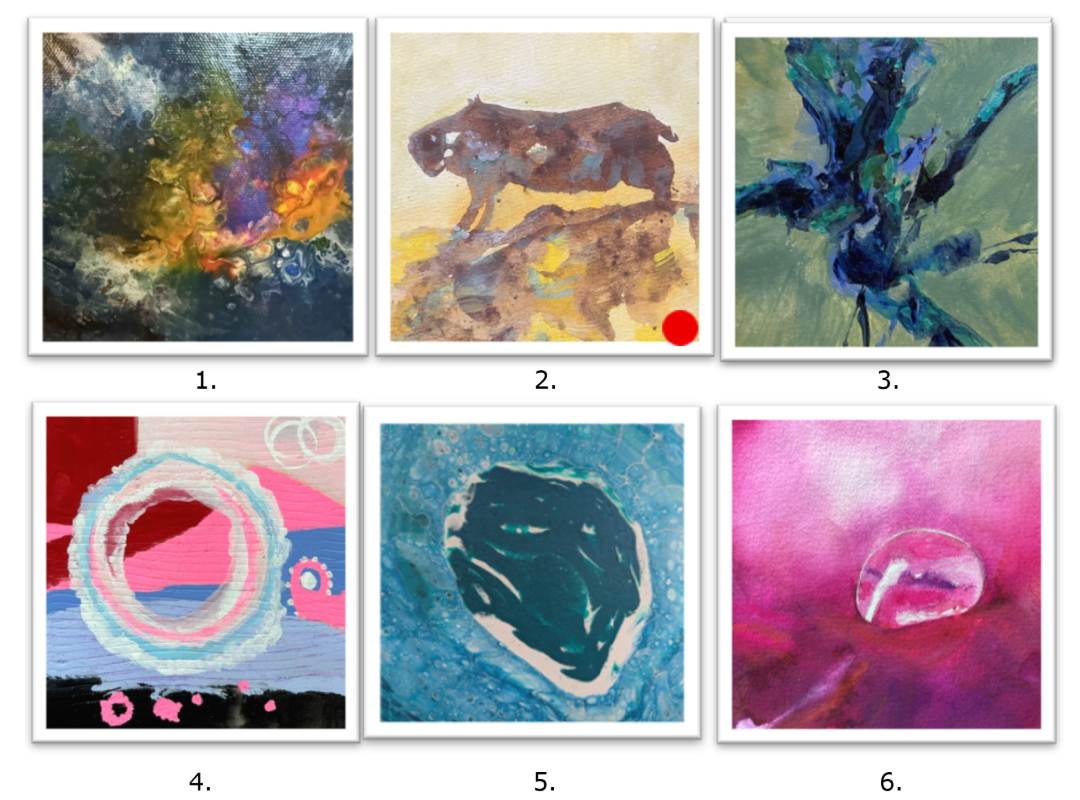
JOIN US!
Many of us have wished we could meet in person and physically embrace each other. That is not possible in our global Focusing village. But we have more ways of relating and communicating and we can physically touch each other by sending our artistic impressions to one another.
The FOTA Art Quilt is an invitation to share your creative spirit with our community — a way of seeing one another, connecting more deeply, and celebrating the many ways we express ourselves.
Through this project, we are finding new ways to relate, communicate, and share our creativity.
ARTISTS:
1. Lynn Preston, 2. Kate Sun, 3. Lynn Preston, 4. Jennifer Leighton
5. Isabel Adon, 6. Sophie Glikson
HOW DOES IT WORK?
You are invited to create a small art piece with one of these sizes: 6” x 6” (15 x 15 cm) or 8” x 8” (20 x 20 cm)
Send a photo of your completed piece to: joke.post@gmail.com.
All submitted pieces will become part of the FOTA Art Quilt which will be published in Dialogues and on the FOTA website as a collective expression of our community.
If an artwork in the quilt speaks to you, you can purchase it by sending $100 USD (or whatever you are able to contribute) directly to the artist. The artist will then mail the original piece to your home.
This is also a fundraiser: 50% goes to the artist and 50% goes to FOTA to support the administrative costs of our programs.
This is more than an art project — it is a way of relating, seeing one another, and sharing our collective creative experience as a living expression of community.
Co-Curators: Joke Post and Laury Rappaport
To learn more about how to participate click:
BEYOND WORDS
Making Space for New Experiences
Triptych Series in Acrylic, Artist: Freda Blob
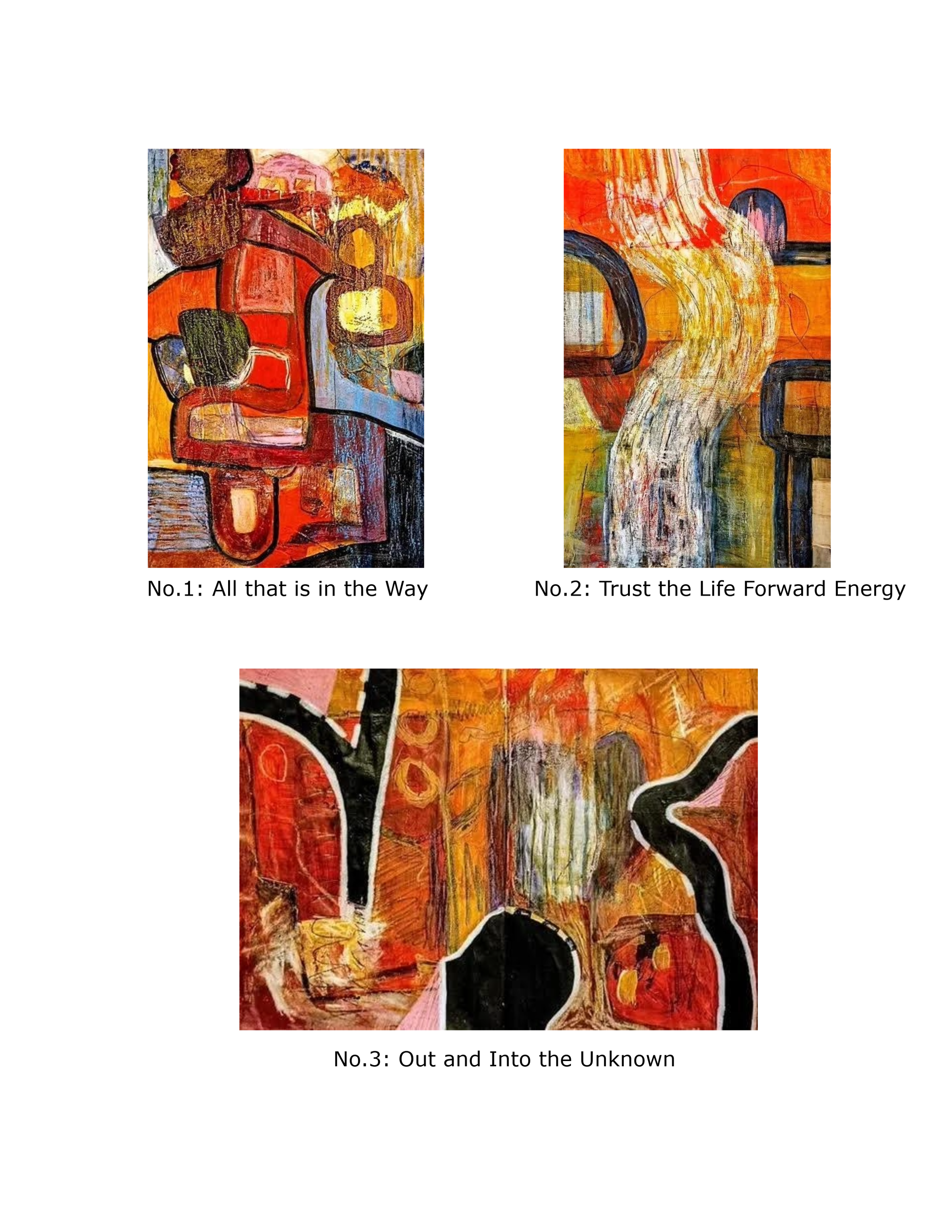
Statement from Freda: “This series is from 2024, when I first started using acrylic paints. I was excited about the thick, pasty texture, and that feeling came through in the theme".
Copyright on the originals and photos: © Freda Blob
We welcome some written reflections on this artwork which we can include in the next issue.
Please send your responses to us at: focusingtherapies@gmail.com
Subject: ARTWORK
78
BEYOND WORDS
80
Press My Lids Together
“You have ten more minutes to play”
“Oh Ma,” pleading.
“It’s getting dark… time to come in.”
Bouncing…bouncing and pavement smacking.
“Time’s up, come in!”
“Ahh..just one more minute, please!”
I don’t want to stop playing.
Not then.
Not now.
Then, it was the youth of a bouncing ball,
chalk marks on the street demarking our jumps for hopscotch;
the thrill of hiding and seeking, especially at dusk.
Now, I won’t press my lids together,
lest the day slip away with the years and decades of a lifetime.
Let me play!
Holding on, pocketing those daylight moments;
resisting the moon and its shadows,
dilly-dallying the night.
Mama,
I want to play,
to write to paint to dance,
to finish the collage, to teach that course;
finally catching the agent’s eye,
the bingo of those illusive abs.
Nah, don’t want to close these eyes;
to stop playing summer night forever.
Robert Axel 12-11-2025
My associations to the process of writing this poem.
As an aging man I find myself often procrastinating my bedtime, not wanting the day to end. Ultimately, the length of my sleep-time is reduced and this is not so good for my health.
My poetry is always an attempt to work something through - an emotional conflict, a psychological concept. I awake in the morning with a burning desire and images and words come to my mind’s eye. One morning I was focusing on this important issue in my life.
I awoke visualizing memories - feeling deep emotions and somehow the past and present merged. Like my child of decades past, I still want to play and create and coming in for the night is an end to the day that I don’t want. Facing mortality is inevitable.
My child and old man merge in Press My Lids Together.
We welcome some written reflections on this poem which we can include in the next issue.
Please send your responses to us at: focusingtherapies@gmail.com
Subject: POEM
BEYOND WORDS
82
Artist: Kate Sun
Title: Untitled
We welcome some written reflections on this artwork which we can include in the next issue.
Please send your responses to us at: focusingtherapies@gmail.com
Subject: COVER ARTWORK
CONTRIBUTORS
John Amodeo, Ph.D., LMFT, is the author of five books, including The Power of Gentle Presence: Insights for Inner Peace and Deeper Relationships.He has been a psychotherapist for over 45 years in the San Francisco Bay Area, and has lectured and led workshops internationally, including at universities in Hong Kong, Chile, Thailand and Ukraine. He was a writer and contributing editor for Yoga Journal for ten years and has appeared as a media guest on CNN, Donahue, NPR, and New Dimensions Radio. You can visit his website atjohnamodeo.com
Robert Axel: I am at my core and artist: painter, poet, actor. And, by profession I am a psychologist who specializes in intimacy enhancement - focusing on our ability to be alone with ourselves and connected with others. I am grateful to be able to live a life of connection and artistic expression.
Freda Blob is the Founding Director of the FOCUSZART Focusing Studio & School. Drawing from her practice and extensive teaching experience with the German-Swiss Focusing Network from 1995 to 2023, she developed the Focusing-Oriented Creative Arts Engagement and Therapy (FOCEAT) approach. Freda is a FOAT-trained licensed art therapist, Registered Person-Centered Creative Arts Therapist, and Registered Person-Centered and Experiential Psychotherapist and Counselor with more than 30 years of professional experience as a clinician and adult educator. She is also a Certifying Coordinator, Focusing-Oriented Therapist, and Focusing Trainer with the International Focusing Institute (TIFI).
Glenn Fleisch, Ph.D., LMFT has been a Focusing oriented therapist for over 35 years. He has been developing a Whole-body animistic orientation especially with clients who have suffered early relational trauma. In addition, Glenn has taught FOT and WBF in person worldwide as well as online. He is the author of many papers and articles and is currently working on a book project.
Rob Foxcroft's life has been shaped by the humanities: by music, dance and stories. His mother was a moral philosopher, a student of Susan Stebbing. Rob read music at Emmanuel College, Cambridge. He learned focusing from Gene Gendlin and became a Focusing Coordinator. Later he learned meditation from Akong Rinpoche and trained in person-centred spiritual accompaniment with Brian Thorne. He wrote a book about meditative listening: 'Feeling Heard, Hearing Others'. He loves to teach listening, focusing, and (of course) music. He means to go on and on.
The simple way to buy Rob's book is by going to: ANTONINE BOOKS – Rob Foxcroft Or by writing directly to Rob: meditativelistening@gmail.com
Charlotte Howorth LCSW, ACC has been in private practice as a psychotherapist for 33 years and currently works in NYC seeing individuals, couples, families, and groups. She has been teaching a Focusing Oriented Psychotherapy certification program for the last 18 years and is lead faculty of the Advanced Coaching Program for Interactualizer, teaching Focusing Oriented Coaching. She is also a teacher for FORGE, NYC (Focusing Oriented Relating in Group Environments), teaches various advanced post-certification programs to therapists and coaches, and has taught workshops internationally for the last 17 years.
Charlotte is also an Organizational Therapist and Coach and for the last 10 years she has worked with a combination of family businesses, medium sized organizations, non-for-profits, and colleges, working with teams’ and leaders’ communication and relational skills.
Susan Lennox, PhD, CPC, is a Focusing-oriented psychotherapist and coach in private practice in Westminster, Colorado. She was certified as a Focusing Professional in 2000 and became a Certifying Coordinator in 2009. Susan is also a Certified IFS Therapist through the IFS Institute and has completed extensive training in inner parts work. She works primarily with mature adults who are seeking healing from early life trauma and a deeper sense of wholeness. Her clinical approach integrates Focusing and Internal Family Systems principles, helping clients develop a compassionate, embodied relationship with their inner experience. She is especially interested in the ways Focusing and IFS can enrich one another, supporting deeper self-awareness, emotional healing, and access to inner wisdom. Susan’s website is SusanLennox.com and she can be reached by email at
Salvador Moreno-López is a psychotherapist, trainer of psychotherapists, and writer. Salvador has published several books, book chapters, and articles on Focusing-Oriented Psychotherapy, Supervision of Psychotherapeutic Work, and The Place of the Lived World in Psychotherapy. His training as a psychotherapist and consultant began with the Person-Centered Approach (Carl Rogers) and later with the Philosophy of the Implicit and Focusing (Eugene Gendlin). However, he approaches his work from an interdisciplinary perspective that connects different sources of knowledge, such as neuroscience, anthropology, sociology, literature, and music, among others.
Greg Madison Ph.D is an existential psychologist and Focusing-oriented psychotherapist contributing to professional communities internationally. He avoids exclusive affiliations and enjoys creative collaborations as an independent practitioner, writer, and creative. He has written and co-edited books and articles on Existential Migration, Focusing-Oriented Therapy, Existential Therapy, and contemporary topics including AI. He’s a Certifying Coordinator for the Focusing Institute, founder of The London Focusing Institute, and host of The Living Process podcast series. Greg is a Canadian living in Brighton, UK. www.gregmadisontherapy.comcontact@gregmadisontherapy.com
Lynn Preston, MA, MS, LP is a long-time psychotherapist, supervisor, teacher and author who integrates the work of Eugene Gendlin and relational psychoanalysis. She has an abiding dedication to studying and teaching the workings of relationality in therapy, community and everyday life. She delights in the process of experientializing theory and finding new conceptual language for lived experience. She collaborated in the creation of the Focusing-Oriented Relating in Group Environments (FORGE) Two-Year International Training Program, which is an outgrowth of the Community Empowerment Project. She is a member of the Focusing-Oriented Therapies Association (FOTA) committee, working on the development of the FOTA YouTube channel as well as its website and quarterly journal, the FOTA Dialogues. She has been hosting Help for Helpers, a weekly online support group for therapists, since 2020 as well as a training seminar in experiential psychotherapy (The Therapeutic Us) for many years.
Kate Sun (Languages: Chinese, English): I'm a certified focusing professional, my life is also filled with art and the practice of law. My unique path allows me to navigate the worlds of inner felt sense, creative expression, and structured logic. I recharge through solitude and find endless inspiration in nature.
83
SUBMISSIONS GUIDELINES
87
Guidelines for Articles
Please submit work in Word doc or Google doc, Verdana font, size 12.
Please keep responses to articles from 250-1000 words.
Please keep your contributor bio statement to 100 words.
We do not accept written work solely generated by AI.
British English and American English spelling and punctuation are welcome. Articles are welcome in all languages.
If you refer to other published works, video, etc in your articles, please include those full references at the end of your contribution. Please format your references in American Psychological Association (APA) style. A quick way to do this is by using Google Scholar:
Find your source in Google Scholar.
Click the "Cite" icon (looks like quotation marks:") below the result.
Select "APA" from the style options.
Copy the citation and paste it into your document.
Please also include the link to any references (such as articles or videos) that may be available online.
If you plan to include client artwork (visual or poetry) in your article, we will need acknowledgement that you have permission from the client to publish their work.
Submit your work to this address: focusingtherapies@gmail.com
If your work is a response to an article, video, or artwork in the previous issue, please be sure to include the Subject keyword provided at the end of the article/artwork etc. For instance: Subject: RELATIONAL FREEDOM
The journal publishes work that carries forward the history, practice and evolution of Focusing-Oriented Therapy.
Guidelines for Videos
We ask that the length of your video submission does not exceed 20 minutes.
Please submit your videos in MP4 format, or as a link to an online video.
Please send large files as a download link; for example, via Google Drive or Dropbox.
Please make sure that:
Audio and video are of good quality.
There is no information that identifies a client
That permission has been granted for use of all music, image or citation used in the video
If your video needs editing, and you are not able to do it yourself, we can do it for you. Depending on the time it requires to do that, we may charge a fee.
Information to include:
Your name
The title of your video
Please submit your work to this address: focusingtherapies@gmail.com
The Subject keyword for video will be VIDEO.
Guidelines for Art and Poetry in “Beyond Words” section
The Journal of FOTA invites creative expressions of Focusing-Oriented Therapists that reflect something meaningful about FOT.
The intention of this section is to invite "the more..." that is beyond words and is often captured through art, poetry, photographs, dance-movement and/or sound. We invite you to share your arts expressions that are connected to you as a Focusing-Oriented Therapist. They may be your own personal reflections or express something about the FOT process for you.
Please note this section is for therapist work, not client artwork.
Arts expressions may include: photos of visual art, photographs, poetry, video of dance/movement, music.
Format of Submissions
Visual art and photography: JPEG, PNG or TIFF format. Include file name: Last name_ Art.jpeg
Poetry: Submit as DOCX or Google Doc; Submit poems flush left
Video: Maximum 3 minutes; format: MP4 or link to an online video
Information to include:
Your name
Art Expressions:
If there is a title, please include the title.
If you would like to offer a brief description of the art piece or its process, please do.
Please submit your work to this address: focusingtherapies@gmail.com
The Subject keyword for visual art will be ART and for poetry POEM.
DIRECTRICES DE ENVÍO
Guías para Artículos
Por favor, envíe su trabajo en formato Word o Google Doc, utilizando la fuente Verdana, tamaño 12.
Mantenga las respuestas a los artículos entre 250 y 1000 palabras.
Limite su biografía del contribuyente a 100 palabras.
No aceptamos trabajos escritos generados únicamente por inteligencia artificial.
Se aceptan las ortografías y puntuaciones del inglés británico y americano, y se mantendrán tal como están.
Se aceptan artículos en todos los idiomas.
Si hace referencia a otros trabajos publicados, videos, etc., en sus artículos, incluya esas referencias completas al final de su contribución. Formatee sus referencias en estilo de la Asociación Psicológica Americana (APA). Una manera rápida de hacerlo es utilizando Google Scholar:
Encuentre su fuente en Google Scholar.
Haga clic en el ícono "Citar" (que parece comillas: ") debajo del resultado.
Seleccione "APA" de las opciones de estilo.
Copie la cita y péguela en su documento.
También incluya el enlace a cualquier referencia (como artículos o videos) que pueda estar disponible en línea.
Envíe su trabajo a esta dirección: focusingtherapies@gmail.com
Si su trabajo es una respuesta a un artículo, video o obra de arte en el número anterior, asegúrese de incluir la palabra clave del asunto proporcionada al final del artículo/obra de arte, etc. Por ejemplo: Asunto: LIBERTAD RELACIONAL
La revista publica trabajos que continúan la historia, la práctica y la evolución de la Terapia Orientada al Focusing.
Directrices para Videos
Solicitamos que la duración de su video de presentación no exceda de 20 minutos.
Por favor, envíe sus videos en formato MP4 o como un enlace.
Envíe archivos grandes como un enlace de descarga, por ejemplo, a través de Google Drive o Dropbox.
Por favor, asegúrese de que:
el audio y el video sean de buena calidad.
no haya información que identifique a un cliente.
se haya otorgado permiso para el uso de toda la música, imagen o cita utilizada en el video.
Si desea que editemos su video por usted.
Si su video necesita edición y usted no puede hacerlo, podemos hacerlo por usted. Dependiendo del tiempo que requiera, podemos cobrar una tarifa.
Información a incluir:
Tu nombre
Título del video
Por favor, envía tu trabajo a esta dirección: focusingtherapies@gmail.com. La palabra clave del asunto para el VIDEO será VIDEO
Directrices para el Arte y Poesía en la sección "Más Allá de las Palabras"
La Revista de FOTA invita a expresiones creativas de terapeutas orientados al enfoque que reflejen algo significativo sobre el FOT.
La intención de esta sección es invitar "a lo más..." que está más allá de las palabras y que a menudo se captura a través del arte, la poesía, la fotografía, el movimiento de danza y/o el sonido. Te invitamos a compartir tus expresiones artísticas que estén conectadas contigo como terapeuta orientado al enfoque. Pueden ser tus propias reflexiones personales o expresar algo sobre el proceso del FOT para ti.
Ten en cuenta que esta sección es para trabajos de terapeutas, no para obras de arte de clientes.
Las expresiones artísticas pueden incluir: fotos de arte visual, fotografías, poesía, video de danza/movimiento, música.
Formato de las presentaciones
Arte visual y fotografía: formato JPEG, PNG o TIFF. Incluye el nombre del archivo: Apellido Arte.jpeg
Poesía: Enviar como DOCX o Google Doc; Envíe los poemas alineados a la izquierda.
Video: Máximo 3 minutos; formato: MP4 o enlace a un video en línea
Información a incluir:
Tu nombre
Expresiones artísticas: Si hay un título, por favor inclúyelo. Si deseas ofrecer una breve descripción de la obra de arte o de su proceso, por favor hazlo.
Por favor envía tu trabajo a esta dirección: focusingtherapies@gmail.com La palabra clave en el asunto para el arte visual será ART y para la poesía será POEM.
91
95
Lignes Directrices pour les Soumissions
Lignes directrices pour les Articles
Veuillez soumettre vos textes sous forme de document Word (DOC/DOCX) ou de Google Doc. Police : Verdana, taille 12.
Les articles et réponses doivent comporter entre 250 et 1000 mots.
La notice biographique du/de la contributeur·rice doit compter au maximum 100 mots.
Nous n’acceptons pas les œuvres écrites générées uniquement par une intelligence artificielle.
L’orthographe et la ponctuation de l’anglais britannique et de l’anglais américain sont acceptées et seront conservées telles quelles.
Les articles sont acceptés dans toutes les langues.
Si votre article fait référence à d’autres œuvres publiées (livres, articles, vidéos, sites web, etc.), veuillez inclure les références complètes à la fin de votre contribution. Merci d’inclure les liens vers toute référence disponible en ligne. Les références doivent être formatées selon le style APA (American Psychological Association). (Un lien explicatif « comment faire » pour le style APA sera fourni.)
Si votre contribution est une réponse à un article, une vidéo ou une œuvre artistique du numéro précédent, veuillez inclure le mot-clé Sujet indiqué à la fin de cette contribution. Exemple: Subject: RELATIONAL FREEDOM
La revue publie des travaux qui prolongent l’histoire, la pratique et l’évolution de la thérapie orientée sur le Focusing.
Adresse de soumission:
📧 focusingtherapies@gmail.com
Lignes directrices pour les Vidéos
Les vidéos peuvent être soumises comme contributions autonomes ou accompagnant un article ou une œuvre créative.
Durée maximale: 20 minutes
Format de fichier: MP4.
Les vidéos peuvent inclure des réflexions parlées, des extraits pédagogiques, des mouvements, de la musique ou d’autres expressions créatives liées à la thérapie orientée par le Focusing.
Merci de veiller à:
une bonne qualité audio et visuelle;
l’absence de toute information permettant d’identifier un·e client·e;
l’obtention des autorisations nécessaires pour toute musique, image ou citation utilisée.
Soumission des vidéos:
📧 focusingtherapies@gmail.com
(Pour les fichiers volumineux, merci de fournir un lien de téléchargement, par exemple via Google Drive ou Dropbox.)
Lignes directrices pour l’art et la poésie dans la section « Au-delà des mots »
L’intention de cette section est d’inviter « le plus… », ce qui dépasse les mots et se manifeste souvent à travers l’art, la poésie, la photographie, le mouvement et le son.
Nous invitons les thérapeutes orienté·e·s par le Focusing à partager des expressions créatives en lien avec leur expérience du FOT. Celles-ci peuvent refléter des réflexions personnelles ou exprimer quelque chose de significatif du processus du FOT.
Remarque importante:
Cette section est réservée aux expressions artistiques des thérapeutes FOT, et non aux productions artistiques de client·e·s.
Le Journal de la FOTA accueille des expressions créatives reflétant quelque chose de significatif à propos de la thérapie orientée par le Focusing.
Formes Artistiques Acceptées
Arts visuels (peinture, dessin, techniques mixtes), photographie
Poésie
Danse-mouvement (vidéo)
Musique ou création sonore (format vidéo)
Formats de Soumission Arts visuels et photographie
Formats : JPEG, PNG ou TIFF
Nom du fichier: Nom DeFamilleArt.jpeg
Poésie
Soumettre en DOCX ou Google Doc; Soumettez les poèmes alignés à gauche.
Vidéo (danse-mouvement ou musique)
Durée maximale: 3 minutes
Format: MP4
Informations à Inclure avec Toute Soumission Artistique
Votre nom
Titre de l’œuvre (le cas échéant)
Brève description (facultative)
Adresse de soumission:
📧 focusingtherapies@gmail.com
