
TABLE OF CONTENTS
PREFACE
4 Preface
Fleisch, Glenn
FEATURED ARTICLES
7 When Our Clients Face Life-Changing Illness
Klagsbrun, Joan
Ellis, Leslie
FEATURED WORKSHOP
34 The Felt Sense Line by Line: Where Haiku Meets the Body’s Wisdom
Obiora, Yaotunde
FEATURED VIDEO
42 Video: Being the Interaction that ‘Makes it Better’ — Finding the Right Distance in Relationship
Howorth, Charlotte
REMARKS TO REMEMBER
44 The 10th FOTA Summit: Integrating FOT with Other Approaches, June 27, 2026
45 Letting‑Play: Wholebody Enacting As a New Paradigm in FOT
Fleisch, Glenn
49 Rogers and Gendlin: Continuing a Living Dialogue — From the FOTA Summit to the Congress in Vienna
Korbei, Lore
52 Integrating FOT with the Arts Therapies
Rappaport, Laury
57 When You Let the Body Lead: Embodied Healing and Change with Contemporary Focusing-Oriented Therapy
Brenner, Helene + Letich, Larry
COMMUNITY CROSSROADS
Post, Joke and Rappaport, Laury, Co-curators
MEMORABLE MOMENTS
Prengel, Serge
BEYOND WORDS
63 Three Paintings of Grandmother
Wing Yee Chan, Grace
Jain, Shashi
Jain, Shashi
ARTWORK ON THE COVER
Blob, Freda
78 Guidelines for Articles
79 Guidelines for Videos
79 Guidelines for Art and Poetry in “Beyond Words” section
81 Guías para Artículos
82 Directrices para Videos
82 Directrices para el arte en la sección “Más Allá de las Palabras”
LIGNES DIRECTRICES POUR LES SOUMISSIONS
84 Lignes directrices pour les Articles
85 Lignes directrices pour les Vidéos
85 Lignes directrices pour l’art et la poésie dans la section “Au-delà des mots”
DOWNLOAD PDF
PREFACE
Glenn Fleisch, Editor-in-Chief
Hello and welcome everyone to the 3rd edition of Dialogues, a journal of the Focusing-oriented therapy association (FOTA). I am most proud to introduce this new edition, one that is rich with depth, creativity and much to explore. First, I want to thank our dedicated and hard-working editorial staff who have put in many hours editing, corresponding with contributors and organizing this whole journal into the wonderful edition that it is. I would like to introduce them by name as they work tirelessly behind the scenes. They are: Joke Post, Peter Ryan, Dorothy Marks, Susan Deisroth, Laury Rappaport and a special thanks to Berkeley Rosenstein, who designs the cover and digitizes and formats all the content into the journal you are reading right now.
This third edition begins with two Feature Articles by two experienced therapists in our FOT tradition. The first by Joan Klagsburn is entitled “When Our Clients Face Life-Changing Illness.” Joan provides clinical vignettes that illustrate each section. She concludes with a moving line: “There can still be a next step; there can still be healing even when curing an illness isn't possible.”
Our second Feature Article is by Leslie Ellis entitled “The Radical Impact of Gendlin's Philosophy: A Summation of Gendlin’s Most Important Articles on Psychotherapy Theory.” In this article Leslie carefully presents three seminal articles by Gendlin, detailing some of the core conceptual and therapeutic ideas that have framed the philosophy and practice of FOT for decades. Leslie also provides vignettes that show how some of these concepts inform our therapeutic practice. She offers an important summation: “It is through direct experience and authentic accompaniment that true change emerges.”
I like to direct your attention to a new section called Featured Workshop. We initiate with a presentation by Yaotunda Obiora called “The Felt Sense Line by Line: Where Haiku Meets the Body's Wisdom.” It is a poetic depiction of the confluence of Gendlin’s felt sense with the ancient tradition of Haiku.
4
The next section is Featured Video, “Being the Interaction that Makes it Better.” which you can view through the shared link. This video that begins with Gendlin is describing his important notion of ‘the doing in the saying,’ then shares two videos of Charlotte Howorth working with Gary and Gosia to find the right distance in relationship.
Our fourth section called Remarks to Remember, presents texts from the four speakers from the 10th FOTA summit. These are: Glenn Fleisch, “Letting-Play: Wholebody Enacting as a new paradigm in FOT”; Lore Korbei, “Rogers and Gendlin: Continuing a Living Dialogue;” Laury Rappaport, “Integrating FOT with the Arts Therapies;” and Larry Letich and Helene Brenner, “When You Let the Body Lead: Embodied Healing and Change in Contemporary Focusing-oriented Therapy.” They are all interesting and informative.
Then we offer our Community Crossroads: FOTA Art-Quilt, a growing and expanding quilt that all are invited to participate and contribute.
We introduce another new section that are short personal sharings of Memorable Moments in the Focusing community that have stood out. This inaugural offering is by Serge Prengel, one he entitles “A Fleeting Moment,” in which he describes his initial encounter with Gendlin, and how it touched him.
Our next section we call Beyond Words, offering artistic and poetic expressions. The first offering is “Three Paintings of Grandmother” by Grace Wing Yee Chan, followed by a dialogue between her and her grandmother. The second offering is two poems called “My Life Sentence” and “Vanity is My Vanity” by Shashi Jain. A deep bow also to our cover artist Freda Blob, whose painting is entitled “Out and Into the Unknown.”
We encourage responses to and comments on any piece- which will be included in our 4th edition. Finally, we would love to expand our readership as well as contributors- so feel free to share and consider sending in an article or artistic creation. We provide much support, help, guidance and care to have your vision or idea be published. Enjoy!
5
You can contact us at: focusingtherapies@gmail.com
6
FEATURED ARTICLE
When Our Clients Face Life-Changing Illness
Joan Klagsbrun, Ph.D.
For most of us, health is in the quiet background, until a severe diagnosis upends the normal course of events. For our clients, the familiar order of one's life can abruptly shift into uncertainty and chaos. A focusing approach calls for a way that can encompass both intense emotions and the disorientation that follows. It can accommodate the stages of the journey as well as capture the bodily experience of such a transition.
Otherwise
I got out of bed
on two strong legs.
It might have been
otherwise.I ate
cereal, sweet
milk, ripe, flawless
peach. It might
have been otherwise.
I took the dog uphill
to the birch wood.
All morning I did
the work I love.
At noon I lay down
with my mate. It might
have been otherwise.
We ate dinner together
at a table with silver
7
candlesticks. It might
have been otherwise.
I slept in a bed
in a room with paintings
on the walls, and
planned another day
just like this day.
But one day, I know,
it will be otherwise.
— Jane Kenyon
When life-changing illness strikes, the predictable rhythms of daily existence are altered. For those navigating serious diagnoses, life suddenly becomes otherwise.
Illness is rarely experienced solely as a medical condition; it is felt as a profound series of losses: loss of control, loss of predictability, and loss of identity. As Focusing-oriented therapists, we can offer a supportive and transformative framework during this critical period. Psychotherapy is not just an adjunct to medical intervention—it can be an important component of making life coherent even in this new and often frightening situation.
Part I: Providing a Roadmap for the Illness As psychologist Gerald May noted, the defining events of life ask us not simply what we are going to do about them, but how we become and remain intact in the midst of them. But it is also true that we can become transformed by these illnesses, depending on how we allow this existential crisis to alter and deepen our whole orientation to living. By providing a clear roadmap of illness, we can help clients regain agency and cultivate resilience.
Given that we Focusing-oriented therapists evoke and welcome the client’s felt sense as a major vehicle of therapeutic change, we can uniquely help clients move through each stage of their illness by allowing words and images to emerge, showing next steps.
8
1. Acknowledging the Diagnosis Through Experiential Listening
The first stage is acknowledging this new reality.
The diagnostic phase can be an emotional rollercoaster—when a person is first diagnosed, fear, grief, and hope can cycle within hours. Well-meaning friends often try to silver-line the diagnosis ("It's only stage one, aren't you lucky?"), which can isolate the patient further.
A Focusing orientation uniquely positions us to meet clients exactly where they are, with radical empathy and non-judgmental presence. The most powerful connection comes through experiential listening. As Rachel Naomi Remen wrote, "Perhaps the most important thing we ever give each other is our attention, especially if it's given from the heart. Most times, caring is even more important than understanding." And Gendlin says, "The essence of working with another person is to be present as a living being." Genuine empathy—showing that we recognize and are moved by the client’s physical or psychological pain—is a vital part of the therapy.
We trust in the client’s process, and they sense that trust. By not rushing to fix it, we offer a spacious, empathic, and non-interfering approach. The Focusing-oriented therapist reflects the essence of a client’s message, helping the client to clarify their inner experience and find authentic steps toward healing.
Client Vignette: Helping the Client Find a Way to Communicate from His Heart
A client was describing his frustration with his wife, who kept advocating for him to get more treatment for his newly diagnosed lymphoma than he wanted to pursue. As I listened, I heard him both wanting to please her and also strongly feeling that it was his body, his life, and his choice of which treatments he was willing to pursue.
9
When I reflected back, “I hear you want to please her, but I also hear something like frustration or annoyance with her,” and asked him if those were the right words for what he felt, he paused and began to tear up.
“No,” he said after a pause, “it is not really frustrated or annoyed.” He waited for a few moments. “I am so disappointed in her wanting me to do what she would choose to do. She is disregarding what I feel is right for me.” After a pause, he said, “Now that is what I will share with her... my sadness and disappointment, not my annoyance.” This moment exemplifies a core practice in FOT. I first offered a reflection, invited the client to check with his felt sense, which then enabled him to sense a deeper feeling that became his next step.
As he got clearer, he was able to have a productive conversation with his wife, who came to support his choice of treatment.
2. Medical Decision-Making
Making decisions is a critical element of managing an illness.
One of the most detrimental aspects of a major illness is the loss of agency, and the difficulty in making choices and decisions. Focusing can assist in helping the client integrate decision-making with his or her sense of what feels authentic and right for this time. Utilizing one’s felt sense is a way to integrate decision-making with the client’s essential knowing.
Modern medicine offers an overwhelming array of options and second opinions. While autonomy is empowering, choice overload causes acute anxiety. Psychotherapists can help clients balance logic and statistics with their intuitive felt sense.
Client Vignette: Slowing Down the Fast Train
A woman diagnosed with ovarian cancer arrived for her session terrified because her surgical procedure was scheduled for Tuesday. She described feeling carsick, as if traveling in a vehicle moving too fast. Pausing for a minute to bring attention directly to her felt sense of nausea, the client realized, "The train is going too fast. I have to slow it down."
10
When asked when it would feel right to have surgery, she checked inside and identified needing seven to nine days to prepare herself. She called her physician to ask if postponing the surgery by a week would be OK. The physician agreed. The client used the time to arrange childcare and meal schedules, and to confirm her choice of surgeon—ultimately approaching her operation with more confidence and doing exceptionally well.
3. Active Treatment
While often physically demanding, treatment can feel emotionally containing because there is a structure and a clear action plan. However, at times the doctor-patient relationship can undermine optimal treatment. Therapists can help their clients discern a better way to engage with their providers and feel agency in dealing with their situation.
Client Vignette: Trusting What Matters Most
Another client planned to travel to Europe for an advanced treatment protocol, flight tickets already in hand. Yet she repeatedly voiced that "something doesn't feel right." Focusing on that something allowed her to realize: "What is healing for me is being surrounded by family and friends. If I go to Germany, I'll be all alone and I will feel like I might lose my hope." Listening to that internal wisdom, she canceled the trip and selected an alternative treatment protocol in the United States where loved ones could remain by her side.
4. Post-Treatment: Adjusting to a New Reality
Paradoxically, the end of active treatment is often a difficult psychological phase. When regular medical monitoring stops, separation anxiety can set in. There is no longer a team to observe and directly manage treatment. Recovery is not a linear return to an old life; it is the construction of a "new normal."
11
Client Vignette: Allowing Herself to Be Cared For
A client who underwent major chest surgery for lung cancer felt immense guilt because her husband had taken a month off work to care for their three young children. Feeling obligated to resume normal duties, she prematurely stopped taking her pain medication against medical advice so she could drive. She found herself sitting through her children's soccer games in excruciating pain, collapsing from exhaustion by 5:00 PM, and missing family dinners.
Bringing her husband into our session allowed him to reassure her that his workplace was fine with him taking an additional month off. Yet the real shift happened when we moved past the surface to address her guilt over missed family moments. By acknowledging the part of her that desperately needed rest, she was able to step back, honor her exhaustion, and finally let her husband help. She was able to take her recovery at a safer pace.
5. Survivorship
Focusing can be very helpful during the survivorship phase, when one tends to re-evaluate priorities, prune toxic relationships, and manage the fear of recurrence. This is a time when Focusing—with its emphasis on trusting the process of allowing meanings to emerge and looking for the small steps of change that grow out of this trust—is particularly helpful.
Client Vignette: Choosing Who Comes In
An AIDS patient who was a client in the 1980s became a teacher for me. He noted that people who wanted to call or visit with him fell into two categories: those who lifted his spirits and those whose anxious lingering made him feel depleted. In therapy, he took time to notice how each friend or relative made him feel in their presence, and then went on to make two lists—individuals who raised his spirits and others whom he felt he had to take care of or who brought him down. His mother acted as his gatekeeper, screening calls and visits according to the list. Surrounding himself only with energizing support dramatically improved his quality of life and his sense of agency.
12
6. The Dying Phase
In this period, the Focusing-oriented therapist can become a steady presence, facilitating honest conversations with loved ones, validating life accomplishments, and helping the individual recognize their enduring role as a teacher to those around them.
Client Vignette: Finding a New Role at the End of Life
Beth, A 39-year-old client who was a corporate CEO of a family business had terminal cancer. Beth had been devoted to her work. But over a few sessions, she expressed regret at her life choices.
“I am afraid I have wasted my time on earth. I should have chosen a career that would make a difference in people’s lives—like becoming a doctor, who would really help people.”
“You’re regretting that your career choice did not help as many people as you could have if you had chosen to become a doctor? Is that right?” I summarized.
”Is that feeling of regret here right now?” I gently asked.
Familiar with this Focusing invitation, she closed her eyes and became quiet. “It is all over,” she whispered as she circled her hands from throat to groin. “There is an aching. A rawness so tender it cannot be touched.”
“Does this rawness have a name?” I asked.
Immediately she responded, “Not good enough. Its name is ‘You have never been good enough.’” And for the next few minutes, the intense sensitivity inside revealed the stinging voice of her father berating her management decisions despite the company’s steady growth and increase in profits under her helm. ‘Not enough,’ she heard his voice.
13
“Can we let that rawness know you heard its pain,” I encouraged.
She nodded silently, and in a few moments, to my surprise, her face brightened. “But now I am hearing the voices of my employees, she said with more confidence. They are exceptionally loyal and kind, and value the decisions I have made. Now something inside is lightening—like taking off a heavy coat I don’t need to be wearing anymore.”
I wondered with her how many people were witnessing not only the success of her company but also her handling of her illness, which she accomplished with so much grace. She realized her partner, family, friends, and entire company of 200 people were witnessing her handling of this devastating illness with strength and transparency. “I feel much lighter,” she shared.
I was visibly touched. “I hope you can let that lightness be as big as it wants to be and stay as long as it wants to.” Recognizing her profound role as a teacher for so many people, increasingly brought her deep comfort at the end of her life.
Part II: Effective Focusing Interventions for Clinical Practices
1. "Clearing a Space"
Derived from Gendlin’s Focusing, Clearing a Space offers clients psychological respite by taking an inventory of physical and emotional burdens and then placing each stressor or burden at a right distance away for the moment.
Taking an inventory: Suggest to the client, "You might notice what is between you and feeling fine right now."Have them locate the physical sensation of the worries in their body without diving into the story.
Placing aside the burdens for the moment: Guide the client to imaginatively wrap each concern into a package or container and place it at a comfortable distance (on a shelf, with a trusted person, or outside the room).
Noticing the background feeling: Check for chronic, implicit background stress (such as "wallpaper anxiety") and then set that aside as well.
Dwelling in the cleared space: Allow the client to spend several minutes experiencing the felt sense of their unburdened self, capturing the experience with a key image or "handle" word (e.g., "open sky" or "stillness").
14
A Session of Clearing a Space
A 35-year-old psychotherapist with metastatic breast cancer utilized weekly Clearing a Space sessions to manage her feelings of overwhelm. In one session, she identified four distinct burdens:
A physical bone pain (imagined wrapped in pillows and placed on a shelf).
Anxiety that her Jewish husband would not raise their children in her Episcopal faith (wrapped in a large box and placed in her minister's care).
Guilt in her solar plexus that her 10-year-old daughter would only remember her as ill (wrapped in silk and handed to me to hold).
A constant background static of anxiety (placed outside the office door).
Once these burdens were set aside, she closed her eyes and experienced a felt sense of resting in the Swiss Alps, hearing cowbells and breathing crisp air. Her "handle" words emerged: "divinely peaceful." Resting in that unburdened space for several minutes allowed her to connect with a spiritual aspect of herself that remained whole and present, despite her illness and her worries. When she returned to the session, she felt more lightness and was more resourceful in addressing her concerns. She reported that dwelling in the cleared space offered her more calm, more clarity, and a larger spiritual perspective, which lingered between our sessions.
15
2. Focusing on the Positive
Cultivating positive emotions directly supports immune function and a sense of resilience. We can suggest, when clients are not in high distress or towards the end of a session, that they pause and bring attention to a time when they felt fulfilled, at peace, or encouraged, and see what positive life-forward direction arises from this reminiscing. Sometimes suggesting a gratitude practice can be very helpful—a daily ritual of pausing to identify three pleasant or uplifting moments to help reframe their perspective. Even in the midst of a hard week, noticing what went well or what brought some lightness can help balance the very real challenges illness brings. Of course, this has to be sensitively addressed.
Reconnecting clients to past passions can also be essential "medicine" for the spirit. Often this entails going back to something that brought pleasure or a sense of flow earlier in life, such as making art, playing or making music, or playing games. Not only does a sense of flow quiet the nervous system and the distracted or troubled mind, but the pleasurable activities reconnect one to parts of their past and perhaps one’s most enjoyed identity.
Client Vignette: Joy Opens the Door
A client struggling with depression following breast cancer treatment reported that "nothing brings me joy anymore--all there is now is heaviness in my chest."
“So joy is sorely missing from your life now and something in you feels such heaviness,” I reflected.
She paused and then said, “Actually, music is the one thing that usually lightens my mood.”
I asked her to remember a specific time when music brought her more alive. She recalled singing in a choir as a young adult and how much joy that used to bring. I could see her energy brighten in remembering those past experiences. This moment of recognition and remembering opened a door she had forgotten. With encouragement, she joined a local choir, which brought her both new community and more vitality. The weekly singing experience also led to further creative expression: she set up a home workspace to create collages using handmade papers she had collected during her travels, creating an artistic outlet for her recovery. Just as there can be a downward spiral in depression, there can also be an upward movement toward positivity: as one’s mood improves, more life-forward energy often becomes available.
16
Part III: Self-Care for the Therapist
Accompanying clients through severe illness and dying inevitably evokes our own fears and vulnerabilities. To sustain our presence without becoming overwhelmed or burned out, it can be helpful to be mindful of how many critically ill clients we are seeing at any one time, avoiding a concentration of loss and grief that may become difficult to carry. It is also important to find ways to process our own anxieties about illness, dying, and the vulnerability of our own bodies. Peer consultation or a Focusing partnership can provide a place to be heard and to attend to whatever fear, sadness, or uncertainty arises in the course of this work. A regular Focusing partnership can be especially valuable, offering a space where we, too, can be accompanied. This becomes even more important when we are working with clients who are at a similar stage of life or whose circumstances resonate deeply with our own.
Grounding activities can also help us return to ourselves between sessions and restore a sense of balance. For some therapists, this might mean yoga, ballroom dancing, making art, playing sports, listening to music, journaling, or simply spending time petting a companion animal. Whatever the form, these practices can help settle the nervous system and create a transition between the intensity of one session and the next.
At the same time, there are profound gifts in accompanying people through illness. Our clients can offer us perspective, enlarge our capacity for compassion and witnessing, and inspire us in our own journeys. We may discover unexpected courage in watching what they are able to endure and how they meet uncertainty, loss, and change. In accompanying them through these difficult passages, we are sometimes reminded of what it means to live with greater presence, courage, and dignity ourselves. We may feel more gratitude in the simple but profound wonder of being alive.
17
Conclusion: Finding a Way Forward When Life Becomes Otherwise
Serious illness makes life otherwise. It disrupts our assumptions about the future, our sense of control, our familiar identities, and often our trust in our own bodies. As the stages outlined here suggest—from the disorientation of diagnosis through treatment, survivorship, and, for some, the dying process—each phase asks something different of the client and calls for a different quality of presence from the therapist. What remains constant across all of these stages is the value of being authentically present and returning to the bodily knowing that holds more wisdom than our rational minds.
Focusing-oriented therapy offers clients a way to stay in relationship with their own experience rather than being swept past it. Whether it is a client slowing down a "fast train" toward surgery, discovering that a rawness in the body carries the name "not good enough," or learning for the first time to let herself be cared for, each vignette points to the same underlying truth—that healing is not only a physical process but a way of finding one’s agency in the midst of deep vulnerability. Clearing a Space and Focusing on the Positive invite clients to trust that some part of them can remain whole and resourceful, even as illness radically alters other parts of their lives.
This work can be challenging—sitting with fear, grief, and dying reminds us of our own fragility and mortality. It asks us to bring our presence and our humanity to accompany another person into places where neither of us knows what comes next. Sometimes we listen. Sometimes we help a client pause and sense inside. Sometimes we offer a reflection, and sometimes—as in the simplest and most human moments—we allow ourselves to be genuinely touched.
18
By accompanying our clients, we help them to discover that even when so much seems to be beyond their control, there is still an inner process unfolding. There can still be a next step. There can still be healing even when curing an illness isn’t possible. There can still be meaning, connection, and an enduring sense of wholeness that illness cannot fully take away.
References
Gendlin, E. T. (1981). Focusing (2nd ed.). Bantam Books.
Gendlin, E. T. (1996). Focusing-oriented psychotherapy: A manual of the experiential method. New York: Guilford Press.
Grindler Katonah, D., & Flaxman, J. (2003). ‘Focusing: An Adjunct Treatment for Adaptive Recovery from Cancer.’ The Folio: A Journal for Focusing and Experiential Therapy, 18(1).
Kenyon, J. (1996). Otherwise. In Otherwise: New and Selected Poems (p. 214). Graywolf Press.
Klagsbrun, J. (1999). ‘Focusing, illness, and health care.’ The Folio: A Journal for Focusing and Experiential Psychotherapy, 18(1), 162-170.
Klagsbrun, J., Rappaport, L., Marcow Speiser, V., Post, P., Byers, J., Stepakoff, S., & Karman, S. (2005). ‘Focusing and expressive arts in therapy as a complementary treatment for women with breast cancer.’ Creativity and Mental Health, 1(1), 107-137.
Klagsbrun, J. (2007). ‘Transforming fear: what we can learn from some people with cancer.’ The Folio: A Journal for Focusing and Experiential Psychotherapy, 20(1), 5-14.
Klagsbrun, J., Lennox, S., & Summers, L. (2010). ‘Effect of “clearing a space” on quality of life in women with breast cancer.’ United States Association of Body Psychotherapy Journal, 49(2), 48-53.
Klagsbrun, J. (2010). When Clients Face Serious Illness: A Focusing-Oriented Approach to Alleviating Suffering. Proceedings from the Body Psychotherapy Conference, October 2010.
Klagsbrun, J., & Lennox, S. (2012). ‘Clearing a space: an evidence-based approach for enhancing quality of life in women with breast cancer.’ The Folio: A Journal for Focusing and Experiential Psychotherapy, 23(1), 155-167.
Klagsbrun, J. (2014). The Body Knows the Way: Working with Clients Facing Illness and Dying. In G. Madison (Ed.), Emerging Practice in Focusing-Oriented Psychotherapy—Innovative Theory and Applications. Jessica Kingsley Publishers.
Klagsbrun, J., & Preston, L. (2015). ‘Don’t Go It Alone: The Power of Focusing Partnership.’ Psychotherapy Networker, May/June 2015.
May, G. M. (1982). Will and Spirit: A Contemplative Psychology. Harper & Row.
Remen, R. N. (1996). Kitchen Table Wisdom: Stories That Heal. Riverhead Books.
19
We welcome some written reflections on this paper which we can include in the next issue.
Please send your responses to us at: focusingtherapies@gmail.com Subject: LIFE-CHANGING ILLNESS
20
FEATURED ARTICLE
The Radical Impact of Gendlin’s Philosophy:
A Summary of Gendlin’s Most Important Articles on Psychotherapy Theory
Dr. Leslie Ellis
In 2011 Eugene Gendlin, the founder of Focusing Oriented Therapy, received his third major award from the American Psychological Association, this one for his distinguished theoretical and philosophical contributions to psychology. In 2016, the year before he died at the age of 90, Gendlin received lifetime achievement awards from both the World Association for Person Centered and Experiential Psychotherapy and the US Association for Body Psychotherapy. His work has made a significant impact on how somatic and experiential therapies are practiced around the world. However, many of Gendlin’s ideas were ahead of his time, and some of the potential impact from his ‘philosophy of the implicit’ is only more recently making its way into mainstream practice of psychotherapy. This article brings some of Gendlin’s radical ideas to light, summarizing three of his most important papers on the theory of psychotherapy.
There are three articles that Focusing teachers from around the world agree are among Gendlin’s most important contributions to psychotherapy theory. Although they are decades old, the ideas expressed in them continue to have a ‘radical impact’ (Ikemi, 2017) on psychotherapy theory. Many of Gendlin’s ideas have filtered into the common parlance of psychotherapy in various ways: proponents of immediacy and mindfulness in therapy, and those who encourage clients to follow their ‘felt sense’ or embodied understanding of an issue are taking their lead from Gendlin. His theories have also been incorporated into Emotion-Focusing Therapy, Somatic Experiencing, and approaches based on Polyvagal Theory. Gendlin’s work sparked a revision of some core concepts, repression for example, which had not shifted appreciably since the days of Freud.
21
A Theory of Personality Change (1964)
In this ground-breaking article, Gendlin (1964) makes note of how the therapy endeavour is often a conversation between the client and therapist about what has gone wrong in their past (their experiences, development, family of origin, etc.) that has made them feel or act the way they now do. Therapy brings new awareness to the client about their past situation, and a realization that they must have felt all of this all along but kept it out of awareness because it was unacceptable or overwhelming. The concept of repression originated with Freud and has not changed much in the past 100 years.
Content versus process
Part of the problem with this conceptualization, said Gendlin, is that it can only explain the personality as it is and does not in theory allow for the possibility of change. It also operates on a ‘content paradigm,’ a sense that in their unconscious people are holding a vast storehouse of fully-formed but forgotten experiences that must be unearthed so the client can understand how they came to be the way they are. There is the inherent assumption that this insight will bring change. What has been repeatedly observed, however, is that “knowing is not the process of changing.” Gendlin (1964) and many others have observed that in fact personality change happens in the context of an embodied emotional process, and in relationship.
Gendlin (1964) developed a theory for this change process that updates the concept of repression with something more plausible. He would say that the past experiences that still plague our clients were not experienced and then forgotten, but rather avoided or stopped before they were fully felt. These pieces of unfinished process are tangible in the body as implicit, as the beginnings of a felt sense that, when attended to and opened, carries rich, complex meaning. These stirrings are not entirely outside of awareness as the term ‘unconscious’ would imply, but rather implicit, waiting at the edge of awareness to finally be turned toward, and invited to unfold. As psychotherapists we have all sat with many clients who bear the wounds from the past, some of these both impactful and unmetabolized. These can show up in dreams, in symptoms, in a sense of something wrong that Gendlin says is already a kind of movement
22
An example might be helpful here. One client I’ll call Gina came to see me because her anxiety was unbearable and nothing she had yet tried offered relief. When invited to sense into her body, she experienced images, vivid metaphors of a deeply isolated self. Together we stayed with these visions of a neglected, disheveled girl trapped an underground bunker, sullen and feral. Over time, as the process unfolded and our sense of mutual connection deepened, the young girl became healthier and a little more open to connection, eventually emerging into the sun. But at first, this imaginal process was as close to a bodily-felt sense as Gina could tolerate; more direct sensing would open up a void in her belly that only heightened her anxiety. The images unfolded alongside early memories of her desperately trying to please a distant, critical mother. This austerity was not news to Gina, not some startling new revelation. However, feeling directly into what was at first so unapproachable was something new. It opened her to a lived sense of what really took place in her early years and led to a sense of not being alone in it for the first time.
The truth brings surprising relief
When we embody and invite the right kind of attention in the present moment to the unfinished sense that lives in our clients' bodies, what was previously implicit can open and be more fully felt. Only then, Gendlin said, can it carry forward. Often, attending to a process that has been stopped leads to painful realizations, likely the reason the process was stopped in the first place. But even when a person comes to realize just how hard this experience is to fully feel, the process of turning toward it and allowing it to unfold brings a sense of relief, an easing of the anxiety surrounding it. This is surprising. Gendlin wrote, “One would have expected the opposite.”
23
Another surprising thing happens as a result of attending directly to the felt sense of even the most intractable issue: “Even when the solution seems further away than ever, still the physiological tension reduction occurs, and a genuine change takes place. I believe that change is really more basic than the resolution of specific problems,” (Gendlin, 1964). What changes in this process is not the external situation, but the entire way the person holds the problem. What often follows such a shift is a flood of realizations, memories and new ways of making sense of old patterns. Gendlin said this dawning of insight is often mistakenly seen as the source of change when it is actually the by-product that follows from a felt shift.
Quality of presence is key
How is it that such a transformative process is facilitated by the presence of another person? Gendlin said that it changes our manner of experiencing immediately when we are with someone else rather than alone. Of course, the nature of the person we are with makes a difference. With a self-oriented, impatient listener we are apt to close off to our experience more than we normally would. However, with a listener who allows us to “feel more intensely and freely whatever we feel, we think of more things, we have the patience and the ability to go more deeply into the details, we better bear our own inward strain… If we have showered disgust and annoyance on ourselves to the point of becoming silent and deadened inside, then with this person we ‘come alive’ again.”
This quality of presence is what allowed the abandoned girl in Gina’s felt experience to feel safe enough to emerge from underground. Gendlin describes this way of keeping company as crucial in supporting our clients to open up to their own selves in the places where their process has stopped. The movement forward in these frozen places is what brings genuine change.
24
The Client’s Client: The Edge of Awareness (1984)
In this article, Gendlin (1984) differentiates feeling from the ‘felt sense’ and explains why following the felt sense, which is not as clear or intense as a feeling, is what leads to change. “People often have the same feelings over and over, quite intensely, without change-steps coming,” Gendlin wrote. Feeling things repeatedly does not discharge them as was previously thought, but actually reinforces them. On the other hand, the vague, murky felt sense leads to a different place, a more subtle sense of something that may never have been directly felt or consciously expressed, and this novelty is what brings a shift.
Gendlin stressed that it is the immediacy of the felt sense unfolding now that gives it the power to transform, not a reworking of the past, which is so often the paradigm for therapy. “Therapeutic steps are not a re-emergence of denied experience. What matters most for change-steps is precisely the new implicit complexity of the bodily living.” The past is always contained in the present experience, but the important difference in Focusing is that it asks a person to attend freshly to what the felt sense brings now, rather than speak from a familiar script or a speculative distance about one’s life experience.
Unfolding freshly, staying with the unknown
Client-centered therapy encourages the therapist to follow the client’s lead, to come with no agenda, no preconceived notions or preset patterns of how we might understand their life experience. We simply allow the other’s process to unfold as it will. For a focusing therapy client, Gendlin’s advice is to invite them to treat their felt sense the way the client-centered therapist ideally treats them. The felt sense is the ‘client’s client,’ (hence the article’s name).
So, as a therapist in this context, our job is to support our client to be gentle, open-minded, curious, and respectful to the inner felt sense that is unfolding in them. We can do this in many ways, including giving gentle reminders to stay with the felt sense, to speak directly from it and not dismiss, banish or assume they already know what it’s about. (The same holds true in working with dreams, a practice where people often make assumptions about the meaning of images or symbols that arise.)
25
This way of approaching therapy changes the manner of the conversation in some striking ways. Clients will typically begin their session by describing all they know about their problems, while a Focusing approach is more concerned with what they don’t know. As a Focusing therapist, our job is to continually bring the client back to the inwardly-sensed ‘unclear edge,’ a place they may be reluctant to stay with. To encourage Focusing, the therapist can inquire into the felt sense in such a way that the client frequently has to stop and check inside.
Invitation to direct experiencing
Gendlin said, “There is a great difference between talking about and pointing.” An example he offers of pointing: when a client says something like, “I must not want to do this (get a job, meet new people, write an assignment) since when the time comes, I don’t do it.” The phrase ‘must not want to’ is speculation, an indication that the not-wanting is indirectly sensed. Rather than simply reflect the not-wanting, the therapist can invite the client to stop and sense the not-wanting directly, to set aside what they think about it and see what is really there. This kind of redirection to the current sense of something can be done whenever you notice such speculation in a session.
For example, Mark came to therapy under stress and feeling isolated. Quick to anger, he was a self-proclaimed ‘tough guy’, a person no one could take advantage of. While it didn’t win him friends, he did command respect, an attitude served him as a trial lawyer. However, he became increasingly isolated in his personal life, not able to stand down with his family or himself. Intellectually, he knew that underneath anger was a fierce need to protect himself, but Mark was unable to feel into his own vulnerability. He could speak about it as a concept, from far outside the actual experience. An opening came the day he talked about unexpected tears while seeing abandoned wolf cubs on a nature show. For Mark, the route to softening to himself and others began with a direct felt sense of the plight of the whimpering pups.
26
Incremental process steps
From this kind of activity, Gendlin observed that “process-steps have an intricacy and power to change us,” and that, “we have to rethink our basic concepts about the body, feeling, action, language and cognition” to explain this. In the remainder of the article, Gendlin offers ten theoretical propositions in support of this major revision in thought.
In the first few theoretical propositions, Gendlin writes about the process of finding words to convey the complexity of ‘feelings-and-situations’ in which we human beings find ourselves. The words come first in our bodies and point to implicit feelings-and-situations. Feelings, “must come or we don’t have them. We can remember them and believe they ought to be there. But to have them they must come. And this is always a bodily coming.”
Reframing repression: the ‘new was’
Gendlin views feelings, thinking, actions and words all primarily as lived experience in the body, and each bodily event as implying what comes next. He calls this ‘carrying forward’ and said, “In therapy we change not into something else, but into more truly ourselves. Therapeutic change is into what that person really ‘was’ all along… it is a second past, read retroactively from now. It is a new ‘was’ made from now.”
From this new was, steps come that change one’s conception of the past entirely. For example, in working with challenging cases of early-childhood trauma we can uncover and process felt-senses of traumatic situations that the person as a child could not assimilate. Their story of childhood, when they first enter therapy, is often that it was fine and normal. But there is a lack of depth and detail which shows they are not truly in touch with their inwardly-sensed experience. When as an adult and with a supportive other they do attend to the felt sense they carry of this early time, it can open up elements of their personality and experience that in Freudian terms would be called ‘repressed’.
27
Gendlin’s newer formulation feels more accurate. He suggests that the trauma memories were never actually repressed. Instead, Gendlin suggests the trauma was never fully experienced in the first place. The mechanism of dissociation explains this as well. When through Focusing the client’s sense of what really happened comes into their body, there is a sense of knowing, a dawning of understanding, a new sense of why they were so withdrawn, anxious, sexualized, or angry as a child. This 'new was' makes sense of both how they experienced aspects of their childhood and of many of their puzzling reactions in the present. It is a carrying-forward that leads to a radical re-conceptualization of their life and often precipitates a flood of feeling, insight, and re-evaluation. It may seem as if the insight is the catalyst for change, but in fact it is the by-product of a deeply experienced change process.
Feeling versus felt sense
Gendlin carefully differentiates emotion from a felt sense. Feelings are often less complex, more recognizable and can be repetitive if nothing surrounding the feeling changes. A felt sense contains the emotion and the whole implicit complexity of a situation. It is “a much larger whole. The implicit situation as a felt sense is a single mesh from which endless detail can be differentiated: what happened to us, what someone did, why that troubled us or made us glad, what was just the also going on… and on.” If a situation feels familiar, repetitive, and stuck, Gendlin says “the stuckness is a finely organized sense of why usual ways won’t do, and of what would.” So even our internally-sensed knowledge that something is wrong and feels like it can’t be fixed contains within it an implicit sense of what would carry the situation forward. When something entirely new is called for, the felt sense can lead to highly creative next steps.
28
There are many situations that call for novel responses to carry them forward, and the felt sense of this can be quite specific. “An odd situation’s implying is more organized than the usual routines, and contains them. The novel implicit is not unrelated to familiar concepts, phrases, and actions. It includes these and exactly why they will not suffice,” (Gendlin, 1984). We can’t speculate but must allow the process to unfold, “like an unfinished poem that very finely and exactly requires its next line.”
The Experiential Response (1968)
This article provides clear guidance for therapists in how to help our clients find the equivalent of that precise next line of their unfinished poem. We need to learn to listen in an unobtrusive way that allows them to carry their own experience forward. This process is not a simple reflection of feelings expressed by the client, but rather a reflection of the intricate felt sense; it involves not just picking up on emotional valence but gathering a sense of the whole of what the client is ‘up against’ (Gendlin, 1968), including the history of the issue, thoughts about it, and all its complexity.
Guiding the client back into their experience
If you as the therapist want to support the client in Focusing, you need to respond not only to the words as expressed but to the larger felt sense that underlies the words in a way that allows the client to inquire further into what they are sensing. You may try many responses that appear to lead nowhere. What is more important than being right about what might lead to an experiential response is simply to keep responding to how the client reacts next. Saying something like, “That didn’t seem quite right for you… can you sense into what would feel more right?” can help move the process forward as effectively as saying something exactly right, which we can never do all of the time. Saying the wrong thing can even make the felt sense more clear to the client, because they get a clear reaction from their body that says, ‘No, it’s definitely not like that,’ which then brings a sense of what is right.
29
A ‘felt shift’ is the only reliable sign of progress
The goal in this process is not deeper understanding or a clearer definition of the issue, but a sense of the experience moving forward toward an internal release that changes how the uncomfortable sense is held in the body. When this happens, Gendlin (1968) says there is “a very distinct and unmistakable feel of ‘give,’ easing, enlivening, releasing.” He called this referent movement or felt shift. He said this is the only reliable sign of progress, and it always feels good, even when what is discovered in the process is not so good.
After a felt shift, it may be easy to go back and make sense of the progress, but before the felt shift, this would not have been possible. The experiential process itself cannot be predicted and moves forward in non-logical steps. In fact, it is not usual for someone who is focusing to contradict something they said earlier in the process and feel both were right at the time. Focusing can transform the felt sense of a situation so completely that was initially seen as a problem no longer seems to be one.
For example Folio editor Paula Nowick wrote a moving piece about how Focusing enabled her to come to terms with the devastation of her son’s addiction. Her felt sense that she was absolutely helpless in the face of his plight ought to have made her feel worse, but instead brought a flood of relief.
Authentic interaction as change engine
Gendlin believed that the most powerful engine for experiencing is interaction, which is why Focusing works so much better with another person (although it is also possible to have an interaction between oneself and one’s felt sense). Our job as the therapist is to offer our authentic reactions to the client, not our theories or even our wisdom:
30
What matters is that the therapist is another human person who responds, and every therapist can be confident that he can always be that. To be that, however, the therapist must be a person whose actual reactions are visible so that the client’s experiencing can be carried further by them…. Only a responsive and real human can provide that. No mere verbal wisdom can.
This does not mean the therapist’s reactions become the centre of attention; it is only the reactions to what the client is feeling, perceiving, and implying that are expressed. At times, when a client has trouble sensing inside or articulating their felt sense, the therapist’s reaction can be the key element in moving the process forward. These responses to our clients don’t always feel clear or good. Gendlin (1968) said, “The therapist cannot expect always to be comfortably in the know. He must be willing to bear being confused and pained, to feel thrown off his stride, to be put in a spot and not find a good, wise, or competent way out.”
Gendlin felt that the therapist must be more open in their interaction than the Focuser would typically experience, and give voice to anything that helps the client “see more clearly what he is up against.” For example, if a client’s responses typically result in rejection by many of those she encounters, the therapist must find a way for the client to succeed where she usually does not. For this to happen, Gendlin believed reassurance or “whitewashing” does not help. “What is bad must be expressed as just as bad as it then is or seems.” However, this honesty must be paired with a response by the therapist to the inherent ‘positive tendency’ Gendlin believed underlies every action.
Gendlin offered the example of how one might respond to being pressured by a client: “I am feeling pressured by you, and that makes me feel like pushing you away, but that isn’t how I usually feel or want to feel with you. So, we’ll do something to clarify it, resolve it, since that isn’t really how you and I are.” The point is not only to be honest about a challenging reaction, but also to then be willing to carry the interaction further “to a positive, life-maintaining, experiential completion which was only implicit and had been stopped and troubled until then.”
31
Summing up
Taken together, these three articles articulate essential ways that therapists can engender an experiential response that helps their clients move forward in areas of their lives that were stuck.
It is through direct experience and authentic accompaniment that true change emerges. Our main job as Focusing oriented therapists has two strands: to offer deeply authentic, empathic company to our clients, whatever they are up against and to keep refreshing their sense of immediate, embodied experience.
These deeply humanistic, optimistic, and profound steps stand in contrast to methods that seek first and foremost to diagnose, or in other words, name a particular problem and apply specific steps, all of which assumes the therapist knows more than the client about how best to proceed.
Gendlin was ahead of his time in trusting the client's own embodied knowing as well as the healing power of relational interactions. The role of the therapeutic relationship has long since been established as a key factor in the effectiveness of therapy, well beyond any specific method.
The role of immediacy and the privileging of direct embodied experience is increasingly valued in our field. What is being articulated by Gendlin in these articles goes beyond mere articulation of method; they explain key aspects of the underlying philosophy that is Gendlin’s major contribution to the theory of psychotherapy.
32
References
Gendlin, E.T. (1964). A theory of personality change. In P. Worchel & D. Byrne (eds.), Personality change, pp. 100-148. New York: John Wiley & Sons.
Gendlin, E.T. (1968). The experiential response. In E. Hammer (Ed.), Use of interpretation in treatment, pp. 208-227. New York: Grune & Stratton.
Gendlin, E.T. (1984). The client's client: The edge of awareness. In R.L. Levant & J.M. Shlien (Eds.), Client-centered therapy and the person-centered approach. New directions in theory, research and practice, pp. 76-107. New York: Praeger.
Nowick, P. (2013). The Light That Focusing Found, The Folio, pp. 152-154.
We welcome some written reflections on this paper which we can include in the next issue.
Please send your responses to us at: focusingtherapies@gmail.com Subject: RADICAL IMPACT
33
FEATURED WORKSHOP
The Felt Sense Line by Line: Where Haiku Meets the Body's Wisdom
Yaotunda Obiora
How an unlikely pairing of a philosopher's inner practice and a poet's three-line form can teach you to listen to what your body already KNOWS
1. Right Now
There is a moment—quiet, unremarkable, and yet profound—when you pause before speaking and notice a sensation in your chest. It is not quite an emotion. Not quite a thought. It is something more primary: a weight, a tightness, a warmth that seems to hold the entire situation in its physical grip. You cannot explain it, but you know it is there.
The philosopher Eugene Gendlin spent his life studying that sensation. He called it the felt sense, and he believed it was the key to genuine change. Not the kind of change that comes from deciding to be different, but the kind that happens when the body itself shifts—when something tight releases, when something murky clears, when a word finally fits.
And then there is haiku—a form of poetry so spare it can seem almost invisible. Three lines. A moment of perception. No explanation, no argument, no moral. Just a frog jumping into an old pond, and the sound of water.
What could these two things possibly have to do with each other? Everything, it turns out. Because both are practices of listening—one to the inner weather of the body, the other to the outer world of sensory experience. And when you bring them together, something remarkable happens: the felt sense finds a form, and the poem becomes a vessel for what was previously wordless.
34
2. Two Teachers, One Practice
Eugene Gendlin was not a poet. He was a philosopher and psychologist at the University of Chicago, a colleague of Carl Rogers, and a man obsessed with a single question: Why do some people change in therapy, and others don't?
His answer, developed over decades of research, was deceptively simple. Change happens when a person learns to attend to the felt sense—the physical, pre-verbal sensation that carries the fullness of an experience before the mind has named it. Gendlin called the process of attending to this sensation Focusing, and he outlined six steps to guide it.
The first step is Clearing a Space—a gentle inventory of what is between you and feeling fine. You acknowledge each concern without diving into it, placing them at a comfortable distance. The second is Felt Sense—choosing one concern and turning inward to sense its physical quality. The third is Finding a Handle—waiting for a word or phrase to rise from the sensation itself, a name that fits. The fourth is Resonating—holding the felt sense and the handle together until the body says yes. The fifth is Asking—deepening contact with questions like "What is the crux of this?" And the sixth is Receiving—simply welcoming whatever shift occurs, without trying to hold onto it.
Meanwhile, haiku has been doing something similar for centuries.
A traditional haiku is a three-line poem, often following a 5-7-5 syllable pattern in English. But its essence is not in the syllable count. It is in the way it pays attention. A haiku does not explain a feeling. It does not tell you what to think. It offers a sensory anchor—a season, a sound, a physical detail—and then places another image beside it, allowing a third thing to emerge in the space between them.
35
Bashō's most famous poem is a masterclass in this:
Old pond—
a frog jumps in,
sound of water.
There is no commentary. No analysis. Just the pond, the frog, the sound. And yet the poem holds an entire world: the stillness before, the disruption, the ripples that follow. The outer event carries the inner meaning.
This is precisely what the felt sense does. It holds a whole situation—its history, its weight, its texture—in a single physical sensation. And when you find the right word or image for it, something shifts.
3. The Bridge: Your Felt Sense Is Your Season
Here is the insight that brings these two practices together: In haiku, the first line often establishes a sensory anchor—season, weather, a physical object. Your felt sense is your "season." It is the weather of your inner world.
When you write a haiku from a felt sense, you are not writing about the feeling. You are writing from it. The poem becomes the feeling, given form.
The process unfolds naturally:
Line 1 captures the sensory anchor—the physical quality of the felt sense. Not "I am anxious" but "chest, a stone." Not "I am sad" but "throat, a closed door." The language is textural, weighted, temperatured. It is the body's own vocabulary.
36
Line 2 offers the handle—the word or phrase that names the feeling. It might be surprising, unusual, true. "Crumble." "Too bright." "Tucked away." It is not an intellectual label but a word that resonates with the body's sensation, that makes the felt sense say "Yes, that's it."
Line 3 provides the juxtaposition—an image from the outside world that mirrors or contrasts the inner landscape. A bird outside the window. The way light falls on the floor. A sound from the street. The outer image holds the inner meaning without explaining it.
The result is a three-line poem that is not about your feeling, but is your feeling—distilled, clarified, and held in a form you can return to.
4. Walking the Path: A Guided Practice
What follows is a condensed version of the process. You can do it alone, in a journal, or with a partner. Find a comfortable seat. Place your feet on the floor. Give yourself twenty minutes of uninterrupted quiet.
Step 1: Clearing a Space
Close your eyes. Ask yourself gently: "What is between me and feeling completely fine right now?"
Let the concerns float up like bubbles—work, relationships, health, that email you haven't sent. Don't dive into any of them. Simply acknowledge each one and imagine placing it in a separate corner of the room. At a comfortable distance. You are not dismissing them. You are creating room.
Now notice how your body feels with that small distance created. Is there a little more ease? A little more breath?
Step 2: Felt Sense and the First Line
From your cleared space, choose one concern. Not the biggest or heaviest—just the one with the clearest signal in your body.
37
Turn your attention inward, like you're listening at a door. Ask: "Where do I feel this in my body? In my chest? My throat? My stomach?" Wait. Let the sensation find you.
Stay with the raw sensation—not the story behind it. Is it tight? Heavy? Hollow? Buzzing? Warm? Cold? Does it have a shape? A texture?
Now write your first line. Use only sensory language. Texture, weight, temperature, pressure. Avoid emotion words like "sad" or "anxious." Instead, write what you sense. For example: "chest, a stone" or "stomach, warm static."
Step 3: Finding the Handle and the Second Line
Ask the sensation: "If this feeling had a single word—not a story, just a word—what would it be?"
Wait. Don't force it. Let the word rise from the body, not from the thinking mind. It might be unusual. It might be "crumble" or "too bright" or "tucked away."
Test it. Say the word quietly to yourself and notice if your body relaxes even a millimeter. A tiny sigh. A subtle release. That's how you know it's true.
Write your second line. Use the word or phrase that emerged as your handle. If it feels right as a single word, let it stand alone. If it needs context, give it just enough.
Step 4: Resonating and the Third Line
Hold the felt sense and the handle together—like two hands clasped. Ask: "Does this word exactly fit the feeling?" If not, adjust it. Change the word. Soften it. Sharpen it. Wait for that subtle body shift—a sigh, a release, a deepening. That is your body saying "Yes. That's it."
38
Now write your third line. Let it be an image from the outside world—a bird outside the window, the way light falls on the floor, a sound from the street. Don't explain the feeling. Let the image carry it.
Step 5: Asking and Refinement
Read your three lines quietly to yourself. Then ask your felt sense one more question: "What is the crux of this? What makes this particular sensation so... this?"
Let the answers come as sensations, not thoughts. You are not problem-solving. You are deepening contact.
Refine your haiku. Read it again. Does each word feel true to the body? Replace any word that feels false—even if it breaks the syllable count. The 5-7-5 is a suggestion, not a cage. What matters is truth, not form.
Step 6: Receiving
Put your pen down. Close your eyes. Hold your completed haiku in your awareness, along with the sensation it came from.
Simply notice: Has anything shifted? A softening? A warmth? A clarity? A quietness?
Don't judge the shift. Don't analyze it. Just receive it. This is the body's "aha."
5. When the Path Is Hard
Not every session will be smooth. Sometimes the body is guarded. Sometimes the mind won't stop talking. Sometimes the poem refuses to come.
If you find yourself numb or blank, know that this too is a sensation. Can you sense the quality of that blankness? Is it empty like a room, or still like a held breath? Name its texture. Start tiny—your left pinky, your earlobe.
39
If you keep telling stories instead of sensing, gently interrupt yourself. Place a hand where you feel the sensation. Don't describe it—just stay with the pressure of your hand there. Now, if that sensation had a color, what color would it be? This bypasses the mind and goes straight to sensory language.
If tears or strong emotion arise, pause. Take a breath. You can stay with the sensation, or you can gently set it aside and return to your breath. Both are okay. Do not rush to fix or comfort yourself with words. Presence and silence are more supportive.
If your mind is completely blank, lower the bar. Write one line describing the room around you—a crack in the ceiling, the way light falls on the floor. Read it to yourself. How does your body respond to that image—even slightly? Let that tiny response be your next line.
If you judge your haiku as terrible, remember: This is not about writing a "good" haiku. It is about writing a true one. Your body doesn't care about syllable count or literary merit. It only cares about accuracy. A "bad" poem that comes from a real place is infinitely more valuable than a "good" poem that comes from nowhere.
6. The Portable Practice
What you have just done is not confined to a workshop or a journal. It is portable. You can do a micro-version in three minutes. You can do it in the morning before you check your phone. You can do it at night before sleep.
Morning: Before you reach for your phone, place a hand on your chest. Ask: "What's here?" Notice the sensation. Name it in one word.
40
Evening: At day's end, write one line—not three—about the dominant sensation of your day.
Anywhere: Pause. Sense. Ask: "What does my body know right now?" Let the answer be a single image.
Over time, you will build a personal lexicon of your inner landscape—a vocabulary of your own felt sense. You will learn to recognize the weight in your chest before it becomes anxiety. You will learn to hear the tightness in your throat before it becomes a swallowed word. You will learn to give form to what was previously formless.
This practice does not ask you to be a poet. It asks you to be a witness. And witnessing yourself is the first step toward being fully alive.
A Closing Haiku
The body knows—
three lines hold what words cannot.
Listen. Then let go.
This article is adapted from a 90-minute workshop on Focusing and Haiku presented by Yaotunde Obiora, at Help for Helpers 8/24/2026, and draws generously from Eugene Gendlin's book Focusing (Bantam, 1981) as well as from the resources of The International Focusing Institute and The Haiku Foundation.
We welcome some written reflections on this paper which we can include in the next issue.
Please send your responses to us at: focusingtherapies@gmail.com Subject: HAIKU
41
FEATURED VIDEO
Being the Interaction that ‘Makes it Better’ Finding the Right Distance in Relationship (18:07)
with Gene Gendlin, Gary Einsidler and Gosia Bochinska
Charlotte Howorth
Gene GENDLIN coined an odd sounding term - “the doing in the saying.” What he meant by this is that how we are being and the way we are interacting is what makes the difference in therapy. In this clip, Gene talks about “being the interaction that makes it better.” He says our way of responding - the “doing” is at the heart of therapy - not the words that are being said. After we hear him lay out this perspective we see two clips of Charlotte working with Gary and Gosia where they find the right distance in their relationship.
In focusing we are more familiar with finding the right distance from our issue and our experience.
In this movement we are finding the place where we are still in contact with what we are feeling but at a comfortable distance from our issues so that we don’t feel overwhelmed and can get a different perspective. In these sessions Charlotte works first with Gary, and then with Gosia to find the right distance in their relationship.
These clips help us to explore how much of therapy, whether explicit or implicit, is about the DOING. In each case, we are working together to find the right distance both from the issue and from each other.
42
We welcome some written reflections on this video which we can include in the next issue.
Please send your responses to us at: focusingtherapies@gmail.com Subject: BEING THE INTERACTION
43
REMARKS TO REMEMBER
FOTA SUMMIT The Forward Edge: The Next 100 Years of FOT: FOT and — Integrating FOT with Other Approaches
Since its inception in September 2024, the Focusing-Oriented Therapies Association (FOTA) has been organizing bi-monthly International Summits, where various topics, from identity and purpose of the organization, to exploring Focusing-Oriented Therapy in the world have been discussed so far.
In this third issue of DIALOGUES we’re sharing contributions from speakers at the 11th FOTA Summit, titled: “The Forward Edge: The Next 100 Years of FOT”: FOT and the Integration of FOT with Other Approaches.
44
Letting‑Play: Wholebody Enacting As a New Paradigm in FOT
Remarks at the 10th FOTA Summit
Glenn Fleisch, Ph.D., LMFT
Introduction: the discovery of whole body implying
I want to begin with one of Gendlin’s central insights: The living body is always implying its right next step. And when that next step cannot or does not happen, the body does not stop implying. It keeps forming and revealing the next step, keeps calling us back until what the body is implying can finally be enacted.
When I included the whole body in FOT, I began noticing that the body was not waiting for us to check inside. It was already implying the next step. This discovery was simple, yet profound: when we are stuck or unclear, our body often shows or does something of its own. These spontaneous expressions emerge from our whole body’s wisdom, and spirit, already implying a next step, not just internally or in words, but in visible embodied expressions.
Implying is thus a bodily expression, both revealing as well as calling, a tightening that wants to release, a reaching that wants contact, a collapse that wants support, a tremor that wants movement, a younger self that wants presence, a creature that wants to express itself.
This revelation shifted my practice and expands Gendlin’s original discovery of Focusing, i.e. that the body’s next step comes from the felt sense, only now extended to the whole body moving outward.
45
Body-leads: how the implying shows itself
Bodily leads are the small, spontaneous movements, gestures, shifts, and “almosts” that show what the embodied self is trying to do or express. They reveal what is implied: the step that has not yet been able to happen, the being that has not yet been able to live forward. When we invite these implicit leads to play out, something essential unfolds:
new realizations emerge
more life‑energy awakens
the implied next step begins to happen
an inner being comes more alive
the body shows the missing or needed relational presence
a specific relational event begins to form
And we can sense this implying in our own body. This co-embodied implying is the crucial link between the client’s own inner emergence and how we can play it out together through our shared embodied relational co-presence.
Implying thus includes a relational need: a missing presence, a needed response, a scene that never happened, a moment that could not unfold. This is why implying frequently calls for co-play, the therapist’s embodied participation that allows the implied step to finally occur.
Letting-Play: the body enacting its implied next step
Letting-play is a natural and organic way the body brings more life. It is how the body enacts what it has been trying to do all along, if we allow it to unfold organically and with radical permission. Sometimes letting-play happens through:
Whole‑body movement- gesture, posture, direction
Imaginal space- creatures, archetypes, animals, nature
Embodied‑self expression- a younger self, a stance, a being
Relational co‑play- a scene enacted together, with my body participating
46
Brief Examples: therapy vignettes
A woman overwhelmed by a family situation says, “I don’t know what to do.” As she spoke, her right hand moved straight forward. Focusing on that gesture revealed a potential undeveloped capacity: “This gesture is showing me what I need-to be clear, firm and set boundaries.” This activated a process of embodying this quality.
A young man feels very stuck in life. “I don’t know why I can’t move forward.” As he shared this, his head moved back and forth, looking at his arms. As we stayed with this movement, he said, “I like to look at my arms. They are muscular and strong.” This opened a pathway to reclaiming his own empowerment.
A woman feels very depressed. “All I want to do is stay in my room. I can’t seem to change.” While saying this. I noticed that her arms and hands are making a semicircular movement over her head. As we focus on this gesture, she has a sudden recognition. “That is exactly what I used to do as a very young girl, climb into bed and pull the covers over my head. It was the only safe place”. This opened a pathway toward caring for that young girl.
Commentary: how the body enacts its next step
As we see in these examples, bodily implying is not just internal but is often revealed through what our body is already doing. It requires that we are not just listening and reflecting words, but observing, attending to and oftentimes, relationally participating in the whole body in action. This brings to life what our body, our embodied being, has been trying to do, and lets it enact itself further with embodied accompaniment.
47
The gesture that shows a potential capacity; the head movement that points to a foreclosed quality; a motion that reveals a younger self needing protection. This is how the body shows its next step- and how we can let it actually happen.
Closing: Embodied enaction as the evolution of FOT
Whole body showing-into-enacting is organic, arising from the body’s own life-force and inner direction. And when we meet what shows with our own embodied presence, when we allow the implied step to be enacted together, trauma patterns that were once unreachable begin to transform. This opens a new horizon for FOT: a future where carrying‑forward happens not only in words, but in shared movement, not only in inner sensing, but in co‑presencing, not only in symbolization, but in playing out together.
Implying is the body’s unfinished movement toward more life. It is an embodied being calling for attention, support, help. Letting-Play is how that movement becomes enacted. Intersomatic co-play is how that movement becomes completed in relationship. FOT becomes more capable of healing the patterns that live not only in the felt sense, but in the whole body, allowing us to continue moving in the right direction.
We welcome some written reflections on this paper which we can include in the next issue.
Please send your responses to us at: focusingtherapies@gmail.com Subject: Letting‑Play
48
Rogers and Gendlin: Continuing a Living Dialogue
Remarks at the 10th FOTA Summit
From the FOTA Summit to the Congress in Vienna
Lore Korbei
How do Carl Rogers’s relational vision and Eugene Gendlin’s Focusing enrich, ground and carry each other forward? This exploration has been unfolding in Vienna for decades—through psychotherapy, Focusing, and a community committed to bringing the “I -You” relating and the “I - Me” connecting into creative relationship.
I spoke to our gathering at the FOTA Summit in June 2026 about my work. By way of introducing myself, I spoke about my longstanding affinity for Focusing and for Gene Gendlin as both a thinker and a person. I have summarized my introduction below:
“I have worked as a psychotherapist in Vienna for more than forty years. In Austria, psychotherapists are part of the national health system, which means that the costs of psychotherapy may be partly or fully reimbursed by state health insurance.
I am coming from social work and Rogers was very much included in my training as a social worker. My theoretical background comes from my Austrian association, the ÖGWG, which began bringing together the approaches of Rogers and Gendlin as early as the 1970s. We connected Rogers’s relational “I - You” expressed in his well-known six conditions, with Gendlin’s Focusing, and the inward “I - Me “connection.”The “I -You” protects Focusing from becoming isolated or purely private. The “I - Me” protects relationships from becoming merely social, intellectual, or guided by expectations. Together, they support a process in which people can remain connected to themselves while meeting others openly and responsively.
49
These two directions are not opposites. They describe two movements that support and deepen one another. Rogers shows us that people grow in relationship. When another person meets us with empathy, genuineness, and acceptance, we feel safer bringing forward what is alive in us. The “I - You” creates a trustworthy human space in which experience can be shared and received.
Gendlin shows us that relationships with others need to be accompanied by cultivating our relationship with ourselves. The “I - Me” relating takes pausing with our own experience, allowing something unclear or not-yet-formed to speak, and finding words or images that come from within rather than being imposed from outside.
In practice, the two movements continually nourish each other. A person may first need the presence of an empathic other in order to turn inward. Then, by listening to the felt sense, that person may discover something new and bring it back into the relationship. The other person can receive it, respond to it, and help it develop further. In this way, inner experiencing is furthered through relationship, while relationship becomes alive and genuine through contact with inner experiencing.
I also want to tell you about The GENDLIN 26 Congress in Vienna. This gathering gave us the opportunity to further the crossing of our two great ancestors.
I think the conference was very successful - engaging and innovative - and I don’t think I am the only one who experienced it that way.
We wanted both the living spirit of Gendlin and of Rogers to be represented at the Congress. We organized the four days in such a way that they were both present with us. We not only invited eminent focusing-oriented speakers who also taught master classes but managed to leave enough space for both focusing partnerships, and also experiential encounter possibilities.
50
Our "embodied dialogues," Lynn Preston and Jan Winhall one day and Akira Ikemi and Leslie Ellis the next day, were engaging for everyone. There was both an English speaking and a German speaking panel. A round table discussion united Lynn, Akira and Leslie; then another with Heinke Deloch, Gerhard Stumm, Astrid Naderer and me.
This conference was meant as a "Birthday Party" for Gene Gendlin. Gerry Gendlin, his son, Leslie Greenberg, Campbell Purton, Teresa Dawson and Johannes Wiltschko spoke a few words about their memories of Gene and shared wishes for the future of Gene’s philosophical and psychotherapeutic heritage. (This part was online.) We ended the conference with small groups talking about plans for the future, issues concerning AI, creativity, and psychotherapy in general.
We welcome some written reflections on this paper which we can include in the next issue.
Please send your responses to us at: focusingtherapies@gmail.com Subject: ROGERS
51
Integrating FOT with the Arts Therapies
Remarks at the 10th FOTA Summit
Laury Rappaport
I’m Laury Rappaport. The roots of integrating Focusing with art goes back to when I was in high school when I would come home from school, shut the door, close my eyes, and wait… After a minute or two, an image would come—not in my mind but in my body. Although I did not think of myself as creative or artistic, I drew what came inside of me (Figure 1).
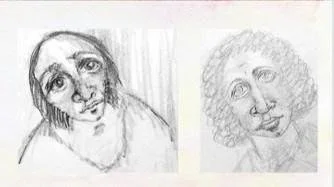
Figure 1: Drawings from within (high school 1970)
The art reflected back something inside that wasn’t clearly known to me. I was able to see my sadness. The process of listening within and expressing what was there, led to a feeling of relief.
In 1977, while pursuing a Master’s degree in art/expressive arts therapy, I became a client in psychotherapy. When a feeling would begin to come up, the therapist would invite me…”Can you sense how that is inside?”. Then there was a pause…quiet…and the therapist’s full unconditional presence, keeping me company. Often an image came. I would return to my apartment and draw what was inside my body. I learned that the therapist was doing something called Focusing, developed by Eugene Gendlin.
52
I immediately began learning what I could about Focusing. I had a huge AHA moment when I was invited to find what Gendlin named a “handle” for the felt sense: Is there a word, phrase, image, gesture or sound that matches the inner felt sense? As an expressive arts therapist, the connection was clear and direct:
A word or phrase can easily become a poem or writing
An image can become a visual art expression
A gesture can become a dance
A sound can become music
Gene always said that Focusing needed to be combined with other things. I had the great blessing of knowing Gene…and he was supportive and encouraging of my combining Focusing with the arts therapies. I began integrating Focusing with every clinical population that I worked with—psychiatric day treatment, outpatient, medical, education, and private practice.
Example
I’d like to share a brief example of a client of mine who was 63 years and going through a painful divorce. I will refer to her as “Sally.” I begin with presence, attending to safety, and compassionately listening, following Sally’s unfolding experiential process. Sally shares about a deep pain and sadness.
T: There’s a deep pain and sadness there. Would it be okay to take a moment to listen to it more?
Sally: (nods) “yes.”
T: Take a gentle breath into your body, feeling the support of what you are sitting on. Take a moment to notice the place inside that feels a deep pain and sadness…and see if you can be curious and friendly to it…(pause). [This is the Focusing Attitude.]
53
…Sense the whole feel of it...
[This is where I feel attuned to Sally, "keeping her company” while gently guiding her to safely “sense the whole feel” of the deep pain and sadness within herself).
T: Is there an image, word, phrase, gesture or sound that matches the inner felt sense?
Sally: There’s a soreness in my chest…[draws a blue and purple heart and writes: “Will it fall apart?” Figure 2). At first, there is just the heart in the drawing].

Figure 2: Felt Sense Expression of “Handle” (Symbol) through Art
T: There’s a hurting bruised heart inside…and a worry…”Will it fall apart?”
We continue the unfolding process, what Gene calls “zigzag.”…keeping the felt sense company… listening to it. I invite Sally to ask the bruised heart: Is there anything it needs?
Sally: I see strong hands holding the heart.
54
She adds two large orange hands holding the heart together with yellow light and blue surrounding the heart and writes, “Strong hands holding the bruised heart together.” (Figure 2). Through this process, Sally found an inner strength to hold the pain and surround it in a healing light.
The things I love about integrating FOT with the expressive arts:
● Art externalizes and symbolizes a felt sense.
● The art process helps the felt sense to open and unfold the life
forward direction.
● The client and I see the same thing. I feel it deepens a sense
of empathic understanding between us.
● A felt shift can be seen in the body and also in the art.
● The art can serve a reminder of what clients want to carry
forward.
● The art reflects the client’s inner wisdom and healing journey!
After 30 years of working with clients, I organized the clinical work into categories, culminating in the publication of my book— Focusing-Oriented Art Therapy: Accessing the Body’s Wisdom and Creative Intelligence. The first three chapters describe Focusing and FOT, while the later chapters elucidate the theory and practice methods of FOAT: Check-in, Clearing a Space with Art, Theme-Directed FOAT (especially useful with groups and for enhancing resilience), and Working on an Issue with the Arts. Specialty applications include, Transforming the Inner Critic, Health and Wellness, Trauma, Spirituality, and Expanding to the Other Arts.
One of the things I feel most proud of is that both Focusing-Oriented Art Therapy and Focusing-Oriented Expressive Arts Therapy (both referred to as “FOAT”) are recognized as core theoretical and methodological approaches within those professions (Rubin, 2016; Malchiiodi, 2024). Please visit the Focusing and Expressive Arts Institute website for articles, books, research, videos, and training: Focusing and Expressive Arts Institute: books, articles, research.
55
References
Rappaport, L. (2009). Focusing-Oriented Art Therapy: Accessing the Body’s Wisdom and Creative Intelligence. London: Jessica Kingsley Publishers. (translated into Japanese, Chinese, Korean, and Spanish).
Rappaport, L. (2016). Focusing-Oriented Art Therapy. In J. Rubin, (Ed.). Approaches to Art Therapy: Theory and Technique, 3rd edition. NY: Taylor and Francis Group.
Rappaport, L. (2023). Focusing-Oriented Expressive Arts Therapy. In C. Malchiodi, (Ed.) Handbook of Expressive Arts Therapy, First Edition. NY: Guilford Press.
We welcome some written reflections on this paper which we can include in the next issue.
Please send your responses to us at: focusingtherapies@gmail.com Subject: ARTS THERAPIES
56
When You Let the Body Lead: Embodied Healing and Change with Contemporary Focusing-Oriented Therapy
Remarks at the 10th FOTA Summit
Larry Letich, LCSW, and Helene Brenner, PhD
Like many of you, we’ve spent years exploring how to help people change in ways that are embodied, deep, real, and lasting. As Focusers, we know how transformative Focusing can be. As therapists, we’ve also seen how hard it can be to bring that depth into the therapy room. Most clients aren’t ready to do deep Focusing right away—or any genuine Focusing, for that matter. They come seeking an interpersonal relationship that will help them with whatever they’re struggling with. That’s totally appropriate. Yet Focusing is a deeply intrapersonal, intrapsychic experience.
The challenge for the therapist, then, is how to combine the two—the healing interpersonal connection and the profound transformation that comes from deeply connecting with the body’s felt wisdom. How do we support both paths toward growth and guide clients to move between them in the most therapeutic way?
That challenge led us to write When You Let the Body Lead: Embodied Healing and Change with Contemporary Focusing‑Oriented Therapy. What we describe in the book, and in our training, is a comprehensive, updated—indeed, revisioned—approach to FOT: one that integrates contemporary emotion and attachment theories such as AEDP and EFT, and adds cutting‑edge neuroscience to create something teachable that a new generation of therapists will recognize as valuable.
57
Another reason for writing the book grew out of years of attending trainings in other modalities—Somatic Experiencing, IFS, EMDR, EFT, AEDP—and hearing how they were using the term “felt sense.” These modalities often credit Gendlin, but they don’t really trust the felt sense. Instead of letting it unfold, revealing its deeply personal meaning to the client, they ask, “What’s the felt sense of that?” and then immediately follow with their own way of manipulating the process.
This felt wrong to us. Many newer modalities claim to improve upon Gendlin’s model of embodied growth and healing, yet they often strike us as less effective. But FOT hasn't been described or defined clearly enough for people who aren’t already steeped in Focusing to appreciate its depth. We wanted FOT to be given its due as a comprehensive modality in its own right, and articulated in a way that would allow clinicians to be systematically trained in it and thoughtful lay people to understand what it is.
So we set out to offer both a contemporary model and something close to a step‑by‑step manual for deepening the level of experiencing within therapy sessions. We grounded it in Gene’s beautiful philosophy of the implicit and linked it with emotion theory and neuroscience—what we now understand about how feelings emerge from the body. We added Ann Weiser Cornell’s Inner Relationship Focusing process, which we’ve found to be a powerful tool for healing inner hurts, including trauma.
We also explored aspects of therapy that go beyond the Focusing process itself. The first is our clinical work with thought‑driven emotions, those generated by mental narratives rather than rooted in the body. Trying to process these in a “pure” Focusing manner can lead people away from resolution, because they’re replaying familiar loops in the mind rather than touching the deep, not‑yet‑known bodily feelings that hold the key to change. The second is how to work with the interpersonal realm—both as it manifests between therapist and client and in the client’s relationships beyond therapy.
58
At the heart of it, we teach how to be with clients—and how to teach clients to be with their own inner experience—so they can listen to hurt, dissociated parts of themselves without being overwhelmed. What emerges is a healing inner dialogue: not two equal parts debating their differences, but a compassionate communication between the Self that can listen and the parts that most need presence and healing. In this process, those cut‑off, unheard parts are reintegrated into the whole Self, freeing the energy that has been locked away.
We also show how to work with trauma in a way that honors the body’s own pacing, with the therapist’s presence as the anchor that lets the client feel safe enough to process feelings that have often gone unfelt and unexpressed for decades. The trauma chapter includes actual case trajectories—clients’ words, used with permission and with identifying details changed. They were dear and brave to let us share them.
Our training program teaches core skills modeled on the EFT and AEDP frameworks: teachable, incremental competencies that help therapists track a client’s inner process moment by moment and recognize the implicit as it forms.
“Embodied” has become a buzzword in psychotherapy lately. What few realize is that Gendlin is, in fact, the originator of embodied therapy. His ideas form the philosophical framework from which many of today’s leading somatic and embodied therapies have emerged. We’ve tried to carry that forward.
When the body is allowed to lead and the mind truly listens, integration begins. The inner self is heard; something synthesizes—quite literally, in the brain—and a new moment is created right then. That is why it works, and why healing happens: not by talking about the experience, but by going to the place where it lives, sensing it, and letting the wise body lead while the mind follows—until the two are joined in a wonderful marriage.
59
COMMUNITY CROSSROADS
FOTA ART-QUILT
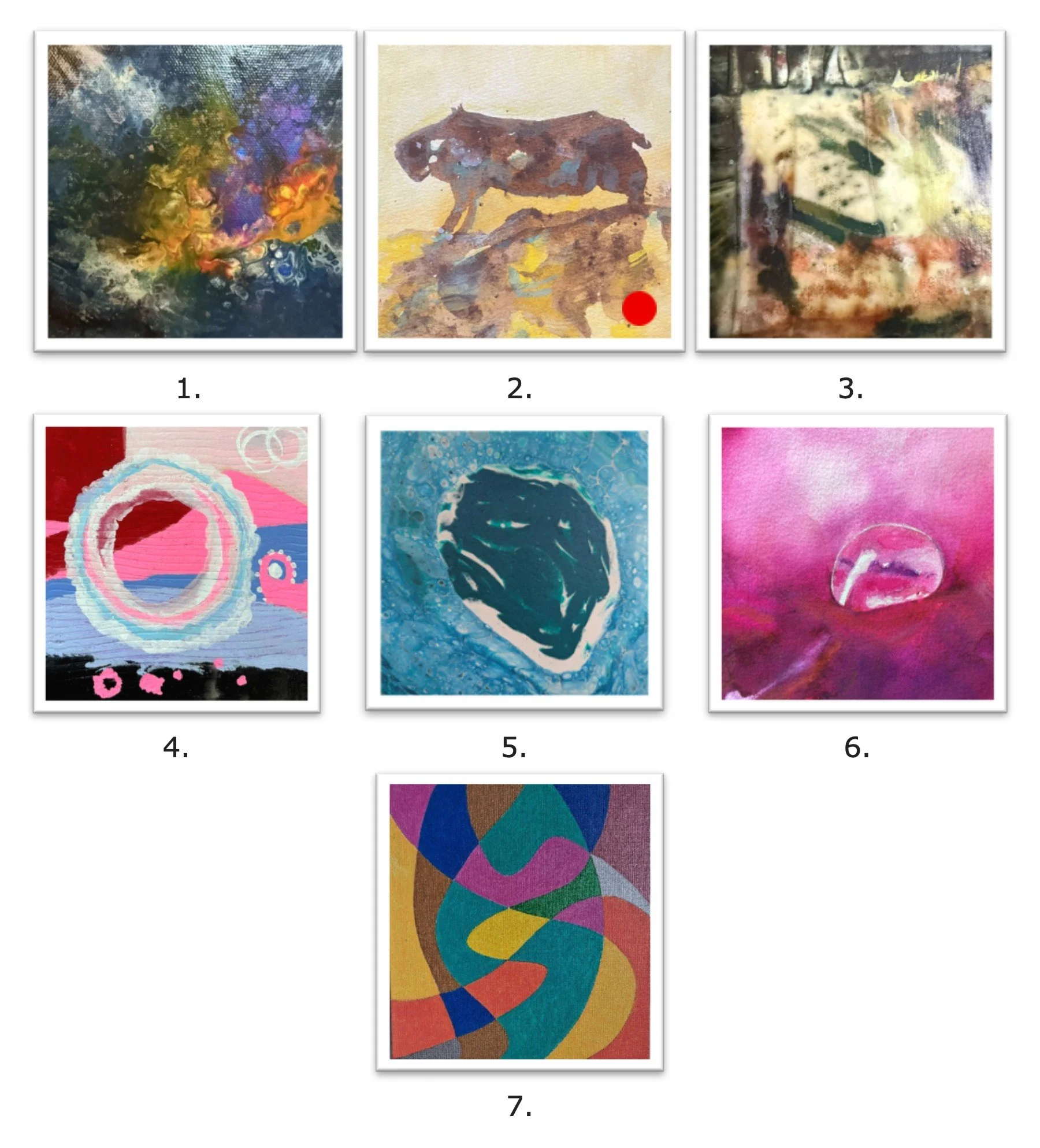
60
PLEASE JOIN US!
Many of us have wished we could meet in person and physically embrace each other. That is not possible in our global Focusing village.
But we have more ways of relating and communicating and we can physically touch each other by sending our artistic impressions to each other.
The FOTA Art Quilt is an invitation to share your creative spirit with our community — a way of seeing one another, connecting more deeply, and celebrating the many ways we express ourselves.
Through this project, we are finding new ways to relate, communicate, and share our creativity.
How does it work?
You are invited to create a small art piece in one of these sizes
6” x 6” (15 x 15 cm) or 8” x 8” (20 x 20 cm)
Send a photo of your completed piece to joke.post@gmail.com.
All submitted pieces will become part of the FOTA Art Quilt, which will be published in Dialogues and on the FOTA website as a collective expression of our community.
If an artwork in the quilt speaks to you, you can purchase it by sending $100 USD (or whatever you are able to contribute) directly to the artist. The artist will then mail the original piece to your home.
This is also a fundraiser: 50% goes to the artist and 50% goes to FOTA to support the administrative costs of our programs.
This is more than an art project — it is a way of relating, seeing one another, and sharing our collective creative experience as a living expression of community.
To learn how to participate click here: Instructions for Art Quilt
61
MEMORABLE MOMENTS
“A Fleeting Moment”
Serge Prengel
It was about seeing Gendlin in person for the first time, at a gathering after he had moved to NYC. Until then, Focusing for me was the book and the lone NYC Focusing trainer who had trained me. Gendlin was the author, the wise professor, who lived in the lofty spheres of Academia.
And I was so surprised, as I was listening to him, to hear these very human emotions in his voice (in contrast to the disembodied tone of wisdom I realized I had been unconsciously expecting). Wow, this guy was human and fallible and imperfect (compared to unflappable and passionless and oh so wise).
There was a brief moment of disappointment, because I had hoped that it was a dispassionate, objective, wise authority that had been proclaiming these things that were so important to me, and, in a way, giving me and kindred spirits a sense that we were “right.” That crumbled in the presence of the reality of a human being who seemed to have subjective emotions just like I did, and was probably not always wise in all he did in his life.
And then I realized I loved that very human vibration in his voice, the sign that he could be driven by some very human emotions and foibles. It was no longer about being right about what I (and we) were doing. It was about finding kindred spirits in a common endeavor.
62
BEYOND WORDS
Three Paintings of Grandmother
Triptych Series in Watercolor and Acrylic
Artist: Grace Wing Yee Chan
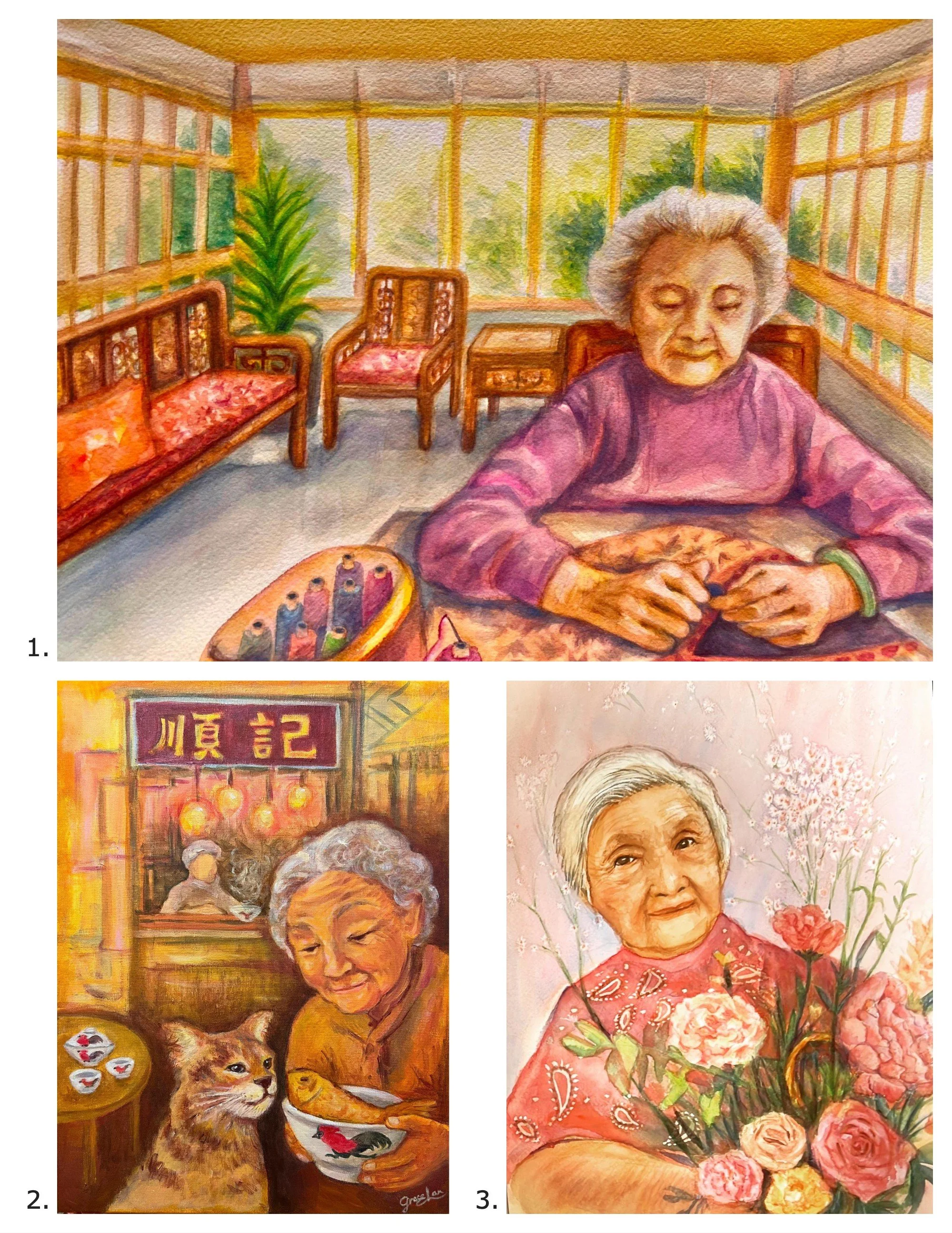
1. Title: The Heavenly Home for Grandma
Medium: Watercolor, 2023 (W16” x H12”)
63
2. Title: Grandma Feeding Stray Cat While Running Food Stall
Medium: Acrylic Painting, 2024 (W 18” x 24”)
64
3. Title: In Remembrance of Grandma
Medium: Watercolor, 2023 (W 12” x H 16”)
The following is a dialogue with the artwork based on the Focusing-Oriented Expressive Arts (FOAT) process. We ask the art a question… and listen to what the art and felt sense have to say.
65
From Grace:
Me: Dear grandma, I miss you so much… sometimes I feel my tears running down when I miss you. Where are you now?
Grandma: I am at my favorite place called heaven. It is my home now. I have my own space here, it is gloriously sunlit, decorated with my Chinese style antique furniture, and I can do what I love here!
Me: Wow, I am happy for you, grandma! I always know you would do well wherever you are… you deserve all the peace and happiness! You are always my inspiration.
Can you tell me how can I age graciously and live my life to the fullness like you?
Grandma: You just have to always trust God and do what you love to do! See, I am still sewing my clothes in heaven, there is really no reason to stop doing what you love to do even when you age. Be creative and love working with your own hands, and love one another, then you will be good!
Me: Oh thanks grandma! You are always encouraging and positive! But what if I fail in what I do with my hands?
Grandma: Oh dear don’t be afraid! See, I used to own a food stall but didn’t manage to sustain it financially. I still have no regrets because all those years I fed many people, my entire family, people in the neighborhood and I fed stray cats too. Sometimes not the result that counts, it is the relationships in the community and the journey that matters!
Me: Aw… thanks grandma! You always know what I need to hear at the right time! So where can I find you when I miss you?
Grandma: My dear granddaughter, you can always look inside within yourself and find me there, isn’t it?
Me: That’s true, I can feel your warmth inside~ you are always there for me indeed!
66
The paintings represent the warmth of grandma. Although she passed away at 104, her light still shines within me… and becomes the warmth inside that I can access anytime when I focus inside.
We welcome some written reflections on this artwork which we can include in the next issue.
Please send your responses to us at: focusingtherapies@gmail.com
Subject: ARTWORK
67
BEYOND WORDS
My Life Sentence
Life is full of sentences.
Some I make.
Many more
are made by others.
My life sentence
has many commas,
semi colons, and colons,
many many question marks
and some exclamations.
All the sentences sent to me
are kept in a large bag
cluttering my closet
taking up space in my mind.
Hoping to parse and part
letters, handwritten
greetings, of birthdays, anniversaries,
memories of a lifetime.
I opened each note.
Many sentences stirred my heart.
Tears trickled down.
Some letters I kissed.
Notes of friends and family,
who are no more.
Scribbles from grandchildren
who are graduating college.
Biggest possible cards
for my anniversary,
thank you notes
of cherished gatherings.
Not a single word
seemed unimportant.
68
Not a single line
I could part with.
No more parsing or
clearing space.
“FULL STOP”
was the right punctuation.
Let them take space,
snuggle into my mind.
I am keeping them all,
close to my heart.
I hope to construct
my life sentences with
correct grammar and punctuation.
A noun, a verb,
subject and an object
all beginning and ending,
with only one word,
“Love”.
-Shashi Jain
BEYOND WORDS
Vanity in My Vanity
Yesterday,
I looked through the magnifying glass
and found one more wrinkle.
That makes it 101.
I perish.
My poor eyes
can barely see.
They refuse to look at those
creases.
My ears,
needing higher and higher volume
absolutely get turned off
69
when I complain.
My feet ache
when I go to the bathroom
to pick up that mirror.
They know the futility.
Don’t you see the cycle
of birth and death?
cries my heart.
Where is your inner beauty?
Why don’t you
Use the magnifying glass
to look for that,
it pleads.
Get Korean facials
once a week.
Get Oil of Olay.
Regenerate your skin.
Keep at it,
says my vanity.
Or simply shatter
that damn magnifying glass.
Replace with
the one
that does not show creases.
I think I will do that.
I am an expert
in fooling myself.
I will hide my vanity
In my vanity.
-Shashi Jain
We welcome some written reflections on these poems which we can include in the next issue.
70
Please send your responses to us at: focusingtherapies@gmail.com
Subject: POEM
71
ARTWORK ON THE COVER
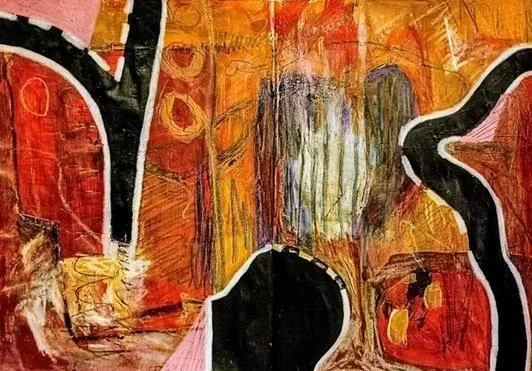
Artist: Freda Blob
Title: Out and Into the Unknown No. 3 of the Triptych Series “Making Space for New Experiences”
We welcome some written reflections on this artwork which we can include in the next issue.
Please send your responses to us at: focusingtherapies@gmail.com Subject: COVER ARTWORK
72
CONTRIBUTORS
Freda Blob is the Founding Director of the FOCUSZART Focusing Studio & School. Drawing from her practice and extensive teaching experience with the German-Swiss Focusing Network from 1995 to 2023, she developed the Focusing-Oriented Creative Arts Engagement and Therapy (FOCEAT) approach. Freda is a FOAT-trained licensed art therapist, Registered Person-Centered Creative Arts Therapist, and Registered Person-Centered and Experiential Psychotherapist and Counselor with more than 30 years of professional experience as a clinician and adult educator. She is also a Certifying Coordinator, Focusing-Oriented Therapist, and Focusing Trainer with the International Focusing Institute (TIFI).
Dr. Leslie Ellis is a leading expert in the use of experiential and somatic approaches for working with dreams, nightmares and the effects of trauma. She is the author of A Clinician’s Guide to Dream Therapy (Routledge, 2025) and offers online training in embodied, experiential dreamwork and nightmare treatment. She has a PhD in Clinical Psychology with a somatic specialization, and a Masters in counselling psychology with a focus on depth/Jungian approaches. She was a psychotherapist in private practice in Vancouver, BC for more than 25 years. She is a former adjunct faculty at Adler University, and past president of The International Focusing Institute, where she is currently a Certifying Coordinator.
Dr. Ellis has published numerous book chapters and journal articles on the use of focusing and dreamwork in psychotherapy - most recently articles on embodied experiential dream therapy, nightmares and the nervous system, and the alarming nightmare-suicide link. Presentations and teaching venues include MIT, PESI, the Polyvagal Institute, The International Focusing Institute, The Academy of Therapy Wisdom, and The International Association for the Study of Dreams. The second edition of her highly respected clinical dream book was published in June 2025.
73
Glenn Fleisch, Ph.D. (Clinical Psychology), LMFT and a licensed psychotherapist in Northern California, USA. He has been practicing as a therapist for 40 years and a Focusing oriented therapist for 25 years. Glenn is a Coordinator with the Focusing Institute, and has taught FOT and Wholebody Focusing worldwide. He has published several articles and contributed chapters in books on Focusing oriented therapy and Client Centered therapy. Glenn is one of the main teachers in the upcoming FOT Academy in which he will be presenting his evolution of FOT from inner body to whole body to animistic relational co-play. His website is: glennfleisch.com and he can be reached at: glfeisch60@gmail.com
Charlotte Howorth LCSW, ACC has been in private practice as a psychotherapist for 33 years and currently works in NYC seeing individuals, couples, families, and groups. She has been teaching a Focusing Oriented Psychotherapy certification program for the last 18 years and is lead faculty of the Advanced Coaching Program for Interactualizer, teaching Focusing Oriented Coaching. She is also a teacher for FORGE, NYC (Focusing Oriented Relating in Group Environments), teaches various advanced post-certification programs to therapists and coaches, and has taught workshops internationally for the last 17 years.
Charlotte is also an Organizational Therapist and Coach and for the last 10 years she has worked with a combination of family businesses, medium sized organizations, non-for-profits, and colleges, working with teams’ and leaders’ communication and relational skills.
Shashi Jain is a licensed Phd psychologist, licensed in New Jersey. She was born and brought up in India. Shashi’s primary language is Punjabi. Even though she obtained her graduate degree from the United States, she feels her English is not as good as a native person's language. She feels that writing poetry gives her the freedom to express her thoughts without having a perfect command of the language.
74
Joan Klagsbrun, Ph.D Focusing has helped me to find and express what is most meaningful and most alive within myself. As a result, I am passionate about teaching this life-giving practice to others. I learned Focusing from Eugene Gendlin in 1976, and since then, I have had the pleasure of teaching Focusing to over a thousand people: the general public; psychology and theology graduate students; and healthcare and mental health professionals. As a practicing psychologist,I have also integrated Focusing into my work with individuals and couples. Since 1998, I have been facilitating training groups for psychotherapists and pastoral counselors, which are competency based, and which can lead to certification as a Focusing-Oriented Therapist or Counselor. Website: http://www.focusingnewengland.com
Lore Korbei After finishing the Academy for Social Work, Lore trained in Person-centered Psychotherapy, Focusing, and supervision from 1981 to 1985. Lore’s career as a psychotherapist and later as a supervisor and instructor spans over forty years in several different countries: Austria, the Ukraine, Romania and Russia.
Lore is a TIFI coordinator for Austria; she received the Science Award of the ÖGWG, MSc (CE) at the Danube University.
The recently published “Personzentriert- Ein Studien-und Übungsbuch mit Lore Korbei”, by Ulle Jäger (2026) is a collection of texts and exercises by Lore Korbei. It contributed to development of the Person-centered approach and Focusing in the German-speaking world.
Larry Letich, LCSW-C, and Helene G. Brenner, Ph.D., co-direct the Center for Contemporary Focusing-Oriented Therapy, where they offer online training programs for therapists and coaches leading to Certification in Focusing-Oriented Therapy. Both are Certifying FOT Coordinators for The International Focusing Institute and teach and supervise therapists and coaches internationally. Their new book is When You Let the Body Lead: Embodied Healing and Change with Contemporary Focusing-Oriented Therapy, with a foreword by Ann Weiser Cornell. They also co-author the Psychology Today blog “The Art of Feeling.”
75
Larry Letich, LCSW-C, is a Focusing-Oriented therapist with twenty-five years of clinical experience specializing in working with men, couples (EFT), anxiety and attachment, and Adult ADHD. A professional writer before becoming a licensed clinician, he is a former columnist for Psychotherapy Networker.
Helene G. Brenner, Ph.D., is a clinical psychologist with over 35 years of experience helping people live more authentically. She studied directly with Eugene Gendlin and Ann Weiser Cornell, integrates Focusing-Oriented Therapy with AEDP and EMDR in her clinical work, and is the author of I Know I’m in There Somewhere (Penguin, 2003).
focusingorientedpsychotherapy.com
Yaotunde Obiora (he, him, and his) is a social work clinician, health activist, human rights advocate and practitioner of healing centered experiences and social justice. His thirty-nine years of post-graduate experience as a social worker has spanned many movements and causes. This has included developing, training or supervising the first ear acupuncture based program aimed to treat addictions in New York City. Advocating and developing the first comprehensive housing program in the nation for persons with HIV/AIDS.
Mr. Obiora gives presentations and training to community-based groups, agencies and organizations, and professional service providers. He lives in the vibrant Dominican enclave of Inwood/Washington Heights across from the Old Dutch Dyckman Farmhouse in Northern Manhattan, with his cat, Gutta.
Serge Prengel is a Focusing-oriented Therapist and Coordinator in the New York City area. He works with clients, trains therapists, and explores creative approaches to mindfulness. Website: ProactiveMindfulness.com
76
Laury Rappaport, Ph.D., LMFT, ATR-BC, REAT is a Certifying Coordinator, FOT, and Trainer with The International Focusing Institute, and the Founder/Director of the Focusing and Expressive Arts (FOAT) Institute. She is the author of Focusing-Oriented Art Therapy: Accessing the Body’s Wisdom and Creative Intelligence, numerous book chapters, and articles. Laury served on the faculty of Lesley University’s Expressive Therapies Division for over 40 years— and has established Focusing-Oriented Art Therapy and Focusing-Oriented Expressive Arts Therapy as recognized approaches within the arts therapies field.
Laury is grateful to be connected with Focusing since the 1980’s—along with the unfolding opportunities for offering training programs in the U.S., Guatemala, Hong Kong, Japan, and other countries.
Grace Wing Yee Chan, BFA, MA, ATR-BC, LCAT.
Grace is a Certified Focusing-Oriented Therapist: Specialization in FOAT® (TIFI). She graduated from New York University with a Master's degree in Art Therapy and is a Board-Certified Registered Art Therapist (ATR-BC) in the United States. .Grace previously worked as a Creative Arts Therapist in the psychiatric unit of New York City Hospital. Since returning to Hong Kong, she works full-time at NGO’s rehabilitation service. Grace serves in individual and group settings for a wide scope of population, including people with mental and physical challenges, elderly with dementia, children with special needs (SEN), as well as their caregivers. She is currently a Focusing Coordinator-in-Training at TIFI, specializing in FOAT®.
77
SUBMISSIONS GUIDELINES
Guidelines for Articles
Please submit work in Word doc or Google doc, Verdana font, size 12.
Please keep responses to articles from 250-1000 words.
Please keep your contributor bio statement to 100 words.
We do not accept written work solely generated by AI.
British English and American English spelling and punctuation are welcome. Articles are welcome in all languages.
If you refer to other published works, video, etc in your articles, please include those full references at the end of your contribution. Please format your references in American Psychological Association (APA) style. A quick way to do this is by using Google Scholar:
Find your source in Google Scholar.
Click the "Cite" icon (looks like quotation marks:") below the result.
Select "APA" from the style options.
Copy the citation and paste it into your document.
Please also include the link to any references (such as articles or videos) that may be available online.
If you plan to include client artwork (visual or poetry) in your article, we will need acknowledgement that you have permission from the client to publish their work.
Submit your work to this address: focusingtherapies@gmail.com
If your work is a response to an article, video, or artwork in the previous issue, please be sure to include the Subject keyword provided at the end of the article/artwork etc. For instance: Subject: RELATIONAL FREEDOM
The journal publishes work that carries forward the history, practice and evolution of Focusing-Oriented Therapy.
78
Guidelines for Videos
We ask that the length of your video submission does not exceed 20 minutes.
Please submit your videos in MP4 format, or as a link to an online video.
Please send large files as a download link; for example, via Google Drive or Dropbox.
Please make sure that:
Audio and video are of good quality.
There is no information that identifies a client
That permission has been granted for use of all music, image or citation used in the video
If your video needs editing, and you are not able to do it yourself, we can do it for you. Depending on the time it requires to do that, we may charge a fee.
Information to include:
Your name
The title of your video
Please submit your work to this address: focusingtherapies@gmail.com The Subject keyword for video will be VIDEO.
Guidelines for Art and Poetry in “Beyond Words” section
The Journal of FOTA invites creative expressions of Focusing-Oriented Therapists that reflect something meaningful about FOT.
The intention of this section is to invite "the more..." that is beyond words and is often captured through art, poetry, photographs, dance-movement and/or sound. We invite you to share your arts expressions that are connected to you as a Focusing-Oriented Therapist. They may be your own personal reflections or express something about the FOT process for you.
Please note this section is for therapist work, not client artwork.
79
Arts expressions may include: photos of visual art, photographs, poetry, video of dance/movement, music.
Format of Submissions
Visual art and photography: JPEG, PNG or TIFF format. Include file name: Last name_ Art.jpeg
Poetry: Submit as DOCX or Google Doc; Submit poems flush left
Video: Maximum 3 minutes; format: MP4 or link to an online video
Information to include:
Your name
Art Expressions:
If there is a title, please include the title.
If you would like to offer a brief description of the art piece or its process, please do.
Please submit your work to this address: focusingtherapies@gmail.com The Subject keyword for visual art will be ART and for poetry POEM.
80
DIRECTRICES DE ENVÍO
Guías para Artículos
Por favor, envíe su trabajo en formato Word o Google Doc, utilizando la fuente Verdana, tamaño 12.
Mantenga las respuestas a los artículos entre 250 y 1000 palabras.
Limite su biografía del contribuyente a 100 palabras.
No aceptamos trabajos escritos generados únicamente por inteligencia artificial.
Se aceptan las ortografías y puntuaciones del inglés británico y americano, y se mantendrán tal como están.
Se aceptan artículos en todos los idiomas.
Si hace referencia a otros trabajos publicados, videos, etc., en sus artículos, incluya esas referencias completas al final de su contribución. Formatee sus referencias en estilo de la Asociación Psicológica Americana (APA). Una manera rápida de hacerlo es utilizando Google Scholar:
Encuentre su fuente en Google Scholar.
Haga clic en el ícono "Citar" (que parece comillas: ") debajo del resultado.
Seleccione "APA" de las opciones de estilo.
Copie la cita y péguela en su documento.
También incluya el enlace a cualquier referencia (como artículos o videos) que pueda estar disponible en línea.
Envíe su trabajo a esta dirección: focusingtherapies@gmail.com
Si su trabajo es una respuesta a un artículo, video o obra de arte en el número anterior, asegúrese de incluir la palabra clave del asunto proporcionada al final del artículo/obra de arte, etc. Por ejemplo: Asunto: LIBERTAD RELACIONAL
La revista publica trabajos que continúan la historia, la práctica y la evolución de la Terapia Orientada al Focusing.
81
Directrices para Videos
Solicitamos que la duración de su video de presentación no exceda de 20 minutos.
Por favor, envíe sus videos en formato MP4 o como un enlace.
Envíe archivos grandes como un enlace de descarga, por ejemplo, a través de Google Drive o Dropbox.
Por favor, asegúrese de que:
el audio y el video sean de buena calidad.
no haya información que identifique a un cliente.
se haya otorgado permiso para el uso de toda la música, imagen o cita utilizada en el video.
Si desea que editemos su video por usted.
Si su video necesita edición y usted no puede hacerlo, podemos hacerlo por usted. Dependiendo del tiempo que requiera, podemos cobrar una tarifa.
Información a incluir:
Tu nombre
Título del video
Por favor, envía tu trabajo a esta dirección: focusingtherapies@gmail.com. La palabra clave del asunto para el VIDEO será VIDEO
Directrices para el Arte y Poesía en la sección "Más Allá de las Palabras"
La Revista de FOTA invita a expresiones creativas de terapeutas orientados al enfoque que reflejen algo significativo sobre el FOT.
La intención de esta sección es invitar "a lo más..." que está más allá de las palabras y que a menudo se captura a través del arte, la poesía, la fotografía, el movimiento de danza y/o el sonido. Te invitamos a compartir tus expresiones artísticas que estén conectadas contigo como terapeuta orientado al enfoque. Pueden ser tus propias reflexiones personales o expresar algo sobre el proceso del FOT para ti.
82
Ten en cuenta que esta sección es para trabajos de terapeutas, no para obras de arte de clientes.
Las expresiones artísticas pueden incluir: fotos de arte visual, fotografías, poesía, video de danza/movimiento, música.
Formato de las presentaciones
Arte visual y fotografía: formato JPEG, PNG o TIFF. Incluye el nombre del archivo: Apellido Arte.jpeg
Poesía: Enviar como DOCX o Google Doc; Envíe los poemas alineados a la izquierda.
Video: Máximo 3 minutos; formato: MP4 o enlace a un video en línea
Información a incluir:
Tu nombre
Expresiones artísticas: Si hay un título, por favor inclúyelo. Si deseas ofrecer una breve descripción de la obra de arte o de su proceso, por favor hazlo.
Por favor envía tu trabajo a esta dirección: focusingtherapies@gmail.com La palabra clave en el asunto para el arte visual será ART y para la poesía será POEM.
83
Lignes Directrices pour les Soumissions
Lignes directrices pour les Articles
Veuillez soumettre vos textes sous forme de document Word (DOC/DOCX) ou de Google Doc. Police : Verdana, taille 12.
Les articles et réponses doivent comporter entre 250 et 1000 mots.
La notice biographique du/de la contributeur·rice doit compter au maximum 100 mots.
Nous n’acceptons pas les œuvres écrites générées uniquement par une intelligence artificielle.
L’orthographe et la ponctuation de l’anglais britannique et de l’anglais américain sont acceptées et seront conservées telles quelles.
Les articles sont acceptés dans toutes les langues.
Si votre article fait référence à d’autres œuvres publiées (livres, articles, vidéos, sites web, etc.), veuillez inclure les références complètes à la fin de votre contribution. Merci d’inclure les liens vers toute référence disponible en ligne. Les références doivent être formatées selon le style APA (American Psychological Association). (Un lien explicatif « comment faire » pour le style APA sera fourni.)
Si votre contribution est une réponse à un article, une vidéo ou une œuvre artistique du numéro précédent, veuillez inclure le mot-clé Sujet indiqué à la fin de cette contribution. Exemple: Subject: RELATIONAL FREEDOM
La revue publie des travaux qui prolongent l’histoire, la pratique et l’évolution de la thérapie orientée sur le Focusing.
Adresse de soumission: 📧 focusingtherapies@gmail.com
84
Lignes directrices pour les Vidéos
Les vidéos peuvent être soumises comme contributions autonomes ou accompagnant un article ou une œuvre créative.
Durée maximale: 20 minutes
Format de fichier: MP4.
Les vidéos peuvent inclure des réflexions parlées, des extraits pédagogiques, des mouvements, de la musique ou d’autres expressions créatives liées à la thérapie orientée par le Focusing.
Merci de veiller à:
une bonne qualité audio et visuelle;
l’absence de toute information permettant d’identifier un·e client·e;
l’obtention des autorisations nécessaires pour toute musique, image ou citation utilisée.
Soumission des vidéos:
📧 focusingtherapies@gmail.com (Pour les fichiers volumineux, merci de fournir un lien de téléchargement, par exemple via Google Drive ou Dropbox.)
Lignes directrices pour l’art et la poésie dans la section « Au-delà des mots »
L’intention de cette section est d’inviter « le plus… », ce qui dépasse les mots et se manifeste souvent à travers l’art, la poésie, la photographie, le mouvement et le son.
Nous invitons les thérapeutes orienté·e·s par le Focusing à partager des expressions créatives en lien avec leur expérience du FOT. Celles-ci peuvent refléter des réflexions personnelles ou exprimer quelque chose de significatif du processus du FOT.
Remarque importante:
Cette section est réservée aux expressions artistiques des thérapeutes FOT, et non aux productions artistiques de client·e·s.
85
Le Journal de la FOTA accueille des expressions créatives reflétant quelque chose de significatif à propos de la thérapie orientée par le Focusing.
Formes Artistiques Acceptées
Arts visuels (peinture, dessin, techniques mixtes), photographie
Poésie
Danse-mouvement (vidéo)
Musique ou création sonore (format vidéo)
Formats de Soumission Arts visuels et photographie
Formats : JPEG, PNG ou TIFF
Nom du fichier: Nom DeFamilleArt.jpeg
Poésie
Soumettre en DOCX ou Google Doc; Soumettez les poèmes alignés à gauche.
Vidéo (danse-mouvement ou musique)
Durée maximale: 3 minutes
Format: MP4
Informations à Inclure avec Toute Soumission Artistique
Votre nom
Titre de l’œuvre (le cas échéant)
Brève description (facultative)
Adresse de soumission: 📧 focusingtherapies@gmail.com
86
